
Every year, in a different location — a secluded luxury hotel or a private resort surrounded by heavy security — approximately 120 to 150 of the most powerful people in the world gather for three days. Current and former heads of state, ministers of finance, defense, and foreign affairs, directors of the world’s largest banks and multinational corporations, editors of major newspapers and news networks, intelligence agency directors, professors from elite universities, kings and prime ministers — all of them meeting behind closed doors, without press, without recordings, without official minutes. They discuss the future of the global economy, international politics, wars and crises. Then after three days they leave in silence. No one announces what was said or what was decided. Only a brief press statement acknowledges that the meeting occurred, listing the participants and some general topics without detail. This meeting is called the Bilderberg Group, and it has occurred every year without interruption since 1954, generating along the way some of the largest conspiracy theories in the world.
The simple question many people ask: why do the most powerful people in the world need to meet in secret? If they are discussing general topics and the welfare of humanity, as they claim, why is the press not permitted to attend? Why are no minutes published? Why does every attendee refuse to discuss what was said? The official answer is that secrecy is necessary for participants to speak freely without fear of media coverage or public reaction. Critics respond that this is precisely what makes it dangerous — a global elite meeting secretly to decide policies that will affect billions of people, with no one knowing what is being planned. And what makes this more troubling is that many of the world’s major decisions and events have followed Bilderberg meetings by only a few months, as though something was decided there and then implemented.
The Beginning at an Isolated Dutch Hotel
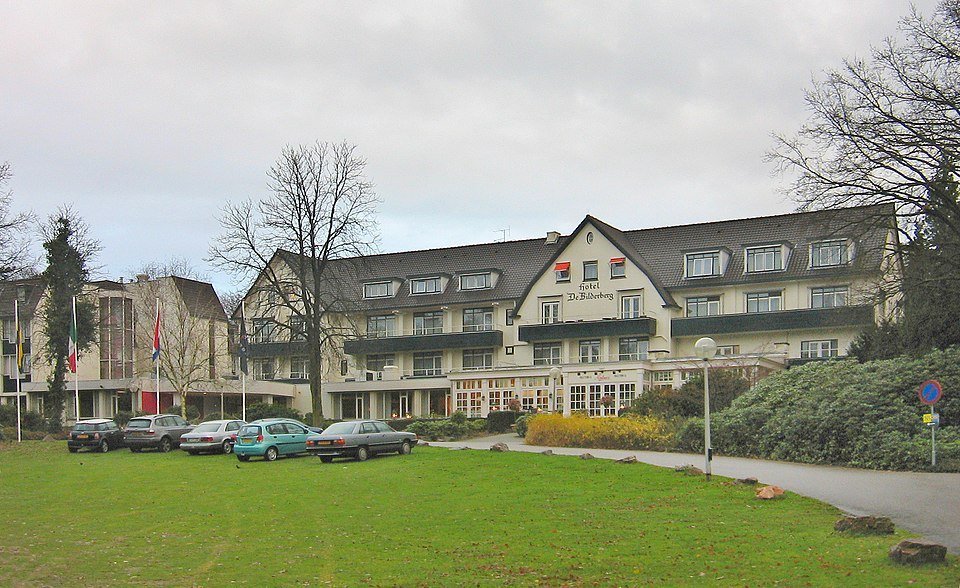
The story began in May 1954 at the small Hotel de Bilderberg in the Dutch village of Oosterbeek. Prince Bernhard of the Netherlands invited 50 members of the European and American elite to meet. The stated goal was to strengthen transatlantic relations during the Cold War — there was concern about the rise of communism and Soviet influence, and the capitalist elite wanted to coordinate a response. Among those who attended the first meeting were David Rockefeller of one of America’s wealthiest families, Joseph Retinger, the Polish political figure who was the intellectual architect of the idea, Denis Healey who would later become British Defence Secretary, and Paul van Zeeland, former Prime Minister of Belgium, along with dozens of politicians, businessmen, and academics. The meeting was entirely secret, no press was invited, and it was successful enough that they decided to repeat it annually. The group was named after the hotel that hosted the first gathering.
From the beginning there were complicating histories. Prince Bernhard himself had been a member of the Nazi party in Germany in the 1930s before moving to the Netherlands and marrying into the royal family. In the 1970s he was implicated in a bribery scandal involving the American aircraft manufacturer Lockheed and was forced to resign from the chairmanship of Bilderberg. David Rockefeller was among the group’s most committed patrons for decades, well known for his advocacy of a “new world order” and global governance. In his memoirs published in 2002 he wrote, with evident pride, that he had worked against the interests of the United States throughout his life to build a single global political and economic structure — and that if this was called a conspiracy, he was guilty and proud of it. This frank declaration from one of Bilderberg’s most important founders lends credibility to the idea that the group is not merely a forum for dialogue but an instrument for shaping global policy.
Who Is Invited and How Are They Chosen?
There are no publicly stated criteria for selecting participants. The list changes each year, though a core of regular attendees remains constant. Invitations are issued by a secret steering committee of approximately 30 people from Europe and America who decide who is invited and who is not. The unstated criteria are clear from practice: you must hold a position of significant power or influence — a head of state, a minister, the director of a major corporation or central bank, a senior editor of a major publication, or an influential academic in policy or economics. The invitation is personal and confidential, and most recipients maintain complete silence about their attendance. Under pressure from critics, the group has in recent years begun publishing participant lists on its website. These lists reveal extraordinary names: prime ministers of Britain, Germany, Italy, and Spain; foreign and finance ministers from dozens of countries; directors of Google, Microsoft, Amazon, and Meta; heads of Goldman Sachs and JPMorgan; directors of major investment funds; editors of the Washington Post, the Economist, and the Financial Times.
A pattern that critics find striking: many politicians who attended Bilderberg meetings while in relatively modest positions rose to the highest offices shortly afterward. Bill Clinton attended in 1991 as Governor of Arkansas and became president in 1992. Tony Blair attended in 1993 as a backbench MP and became Prime Minister in 1997. Emmanuel Macron attended in 2014 as a relatively obscure economic adviser and became President of France in 2017. These patterns recur frequently enough that some researchers describe Bilderberg as the waiting room for world leaders — a place where promising politicians are evaluated by the global financial and media elite before being propelled upward with the network’s support.
The Decisions That Become Reality
One of the most frequently cited concerns is the correlation between Bilderberg discussions and subsequent world events. At the 1955 meeting, the creation of a European common market was discussed; two years later the process began that would eventually produce the European Union. At the 1973 meeting, oil prices and the energy situation were discussed; months later the oil crisis struck, quadrupling prices and affecting the global economy for years. Critics argue this was not coincidence but coordination between major oil companies and Western governments on how to manage the crisis. At the 1991 meeting, the breakup of Yugoslavia was discussed; the wars that tore the region apart through the 1990s followed. At the 2002 meeting, Iraq and weapons of mass destruction were discussed; the following year America invaded Iraq on the basis of weapons that were never found. At the 2008 meeting, months before the global financial crisis, risks in mortgage markets and financial bubbles were discussed — yet no action was taken to prevent the collapse, and when it came, the major banks whose directors and owners attended Bilderberg were the ones that received billions in taxpayer bailouts while millions of ordinary people lost their homes and jobs.
The Absolute Secrecy and the Heavy Security
Every Bilderberg meeting is surrounded by security arrangements resembling those of a heads-of-state summit: hundreds of police and private security personnel, checkpoints kilometers from the hotel, flight restrictions over the area, cameras and jamming equipment and advanced security technology. Any journalist or activist who attempts to approach is arrested or forcibly removed. In 2013 in Britain, dozens of journalists and activists attempting to approach the venue were detained. In 2019 in Switzerland, police used drones and advanced surveillance technology to keep anyone from filming or recording at a distance. Inside the hotel there are no audio or video recordings permitted, smartphones are not allowed in meeting rooms, staff are brought in from private security firms rather than the hotel’s regular employees, and everyone present signs a strict confidentiality agreement. The Chatham House Rule applies rigorously: anyone who attends may use information they hear but may not reveal who said it or even officially confirm that the meeting occurred. A finance minister can return to his country and implement an economic policy based on what he heard at Bilderberg without disclosing where the idea came from. Decisions are made without the public knowing their origin or rationale.
The Rare Admissions from Inside
Very few of those who have attended Bilderberg have spoken publicly about what transpired. Most maintain silence for life. But some, after retirement or in memoirs, have offered fragments. Denis Healey, one of the founders, said in a 2001 interview: “We meet to decide how the world ought to be run — not conspiratorially, but practically. The world is complex and requires coordination among elites. Democracy is good but slow and inefficient. We accelerate things.” This candid statement reveals the core mentality: they see themselves as wiser than the public and entitled to make decisions on behalf of billions. Etienne Davignon, a former secretary-general of the group, said in 2011 that no decisions are made and nothing is voted on — only dialogue and exchange of ideas. Critics note that this claim is difficult to reconcile with the observable patterns: why do politicians consistently rise after attending? Why do so many discussed topics become policy? In 2005, a Dutch journalist infiltrated the hotel disguised as a staff member and managed to record corridor conversations — not from inside the meetings themselves, but revealing discussions about managing public opinion, coordinating media messaging, and determining which political figures should rise and which should be sidelined. The recordings received little attention in mainstream media. In 2009, a young British parliamentarian who received an invitation wrote on his blog after returning that he was uncomfortable with the secrecy and with the way the world was being discussed as though it were a playing field controlled by a small group. He deleted the post days later and refused further comment; it is said he received pressure to remain silent.
The Global Order Planned in the Shadows
Today Bilderberg is no longer a complete secret — the internet has made the meeting impossible to hide entirely. Thousands of activists protest outside the hotels each year, independent journalists attempt coverage, and websites and channels analyze the participant lists and stated topics in detail. But despite all of this, the group continues to meet each year with the same secrecy. No minutes are published, no decisions announced, no transparency offered. And the concentration of power in one room grows. At the 2023 meeting in Lisbon, attendees included Ursula von der Leyen, President of the European Commission; Jens Stoltenberg, Secretary General of NATO; directors of BlackRock and JPMorgan, among the world’s largest investment funds; directors of Google and Microsoft; and editors of leading Western publications. These individuals command enormous financial, political, and media power — and they meet privately to discuss something, then return to their positions and act.
Perhaps Bilderberg is exactly what it claims to be: a forum for candid dialogue among influential people who find it useful to speak freely away from cameras. Or perhaps it is something more consequential — an unelected board of directors for the planet, a global elite that shapes major policies and implements them through members placed throughout governments, corporations, and media. Perhaps the democracy we experience is a facade and the real decisions are made in secluded luxury hotels by people we do not know and did not elect. The question that remains: does 120 people have the right to decide the fate of billions? Is absolute secrecy compatible with democratic governance? What is planned in those closed rooms? And what will follow the next meeting? No one will say. That, precisely, is what makes Bilderberg unsettling — that real power operates in the shadows, beyond public view, beyond accountability, beyond the reach of the people it governs.