
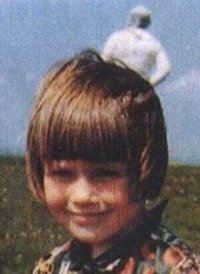
On a quiet summer day in 1964, Jim Templeton, a local firefighter, took his family to the Solway Firth marshlands in Cumbria, England. During the outing, Templeton photographed his young daughter Elizabeth three times. Neither he nor his wife noticed any unusual movement or the presence of any strangers — the area appeared completely empty of other people at that moment. The shock came when the film was developed. In one of the photographs, a figure appeared standing clearly behind the child, dressed in a complete white suit with a large helmet that closely resembled the design of a space suit — a garment that had no civilian equivalent or common availability in 1964. The image attracted immediate and widespread attention.
The Technical Investigation and the Men in Black
The photograph reached Cumbria Police and the Kodak Corporation. The company subjected the original film negative to a series of precise examinations to determine whether double exposure or any form of manipulation had occurred. The result was unambiguous: the photograph was assessed as one hundred percent authentic, with no evidence of tampering. The mystery deepened when two men in dark suits visited Templeton’s home, claimed to represent a government agency, and attempted to question him in a manner he described as unsettling — pressuring him to acknowledge that what he had photographed was simply “an ordinary man.” When he refused to accept their account, they left abruptly and were never identified. The visit itself, with no credentials presented and no follow-up contact, became a secondary element of the case that researchers have debated alongside the photograph itself.
The Competing Explanations
Analysts have attempted to explain the image across several decades. Skeptics proposed that the figure was Templeton’s wife walking away from the camera, and that overexposure had rendered her dark blue dress white in the developed photograph. Templeton and a number of visual analysts rejected this explanation, pointing to the posture of the shoulders, the shape and size of the upper structure, and the apparent helmet form, none of which they considered consistent with a woman’s figure in typical 1960s clothing. The photograph has remained in circulation as one of the most discussed unresolved images in the history of anomalous photography.
The Mysterious Archive’s Assessment: A Technical and Visual Analysis
From a photographic and physical standpoint, the Solway Firth Spaceman is a textbook case of overexposure acting on a person who was present in the frame — not an external or unknown entity. Modern digital analysis conducted by imaging specialists indicates that the figure is almost certainly Templeton’s wife Annie, standing with her back to the camera at the moment of exposure. She was wearing a dark blue dress. Under the strong outdoor lighting conditions of that day, combined with the camera’s overexposure, the blue tones in the developed image shifted to pale white — producing the visual impression of a white suit. What appears to be a helmet is the product of her head’s position, the angle of her short hair against the background, and the overlapping shadows behind her, which combined to create an irregular geometric shape that the brain interprets as a structured object.
The mechanical explanation for why Templeton did not notice her presence is precise and straightforward. The viewfinders of consumer cameras in the early 1960s displayed only approximately seventy percent of the actual frame captured by the film. A person standing at the upper edge of the image — as Annie appears to be — would have been partially or entirely outside Templeton’s line of sight at the moment he pressed the shutter. He photographed his daughter, and his wife happened to be standing behind her in a position he did not see through the viewfinder and did not register consciously as present. From the standpoint of analytical optics, the photograph contains no manipulation and no anomaly — only a human error in situational awareness that converted an ordinary family outing into an enduring legend. The case is worth examining precisely because it illustrates how ordinary photographic mechanics, ordinary human perception limits, and the subsequent framing of an image by witnesses and media can produce a mystery that resists resolution for decades even when the explanation is technically straightforward.