
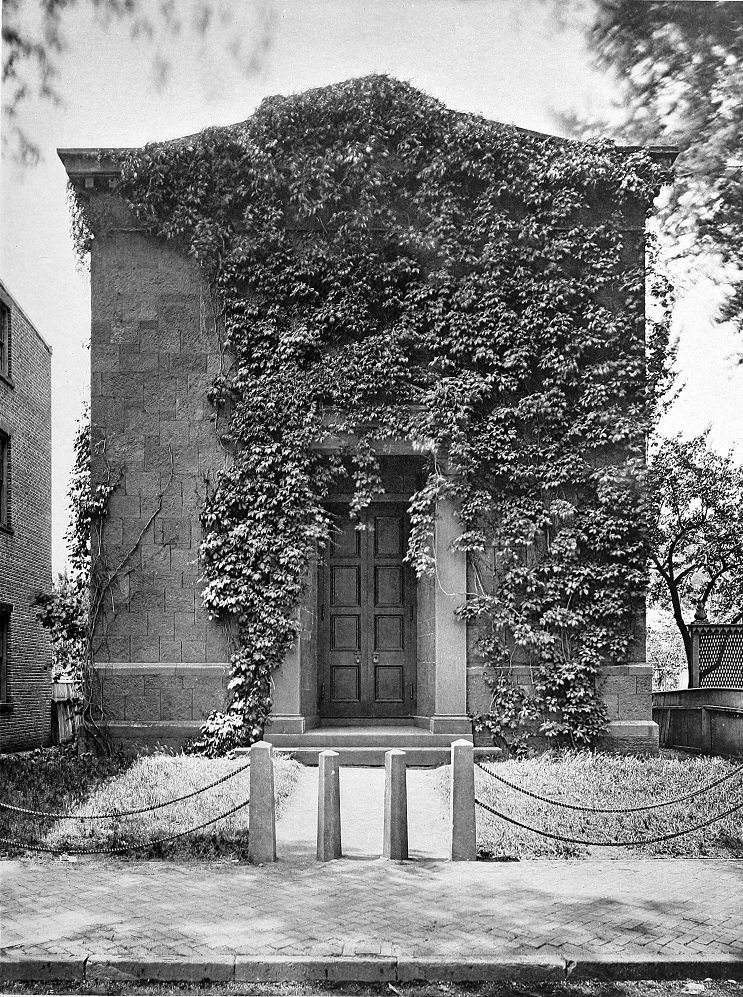
At the heart of Yale University, one of America’s oldest institutions, stands an old stone building with no windows known as the Tomb. It is a forbidding, completely sealed structure that has admitted only fifteen specially selected students each year since 1832. These students are not ordinary. They are sons of the most powerful families in America — families that have held wealth, authority, and influence for generations. What happens inside that building is known to no one with certainty: strange rituals, a lifelong oath of silence, a network of bonds that ties members to one another permanently. The organization is officially called the Order of Skull and Bones, though members refer to it simply as the Order or the Brotherhood. In the nearly two centuries since its founding, it has produced three American presidents, dozens of senators, Supreme Court justices, directors of the Central Intelligence Agency, and chief executives of the country’s largest banks, oil companies, and media corporations — an invisible web of power threaded through every institution of the American state.
What makes the organization genuinely unsettling is not only who belongs to it, but the absolute secrecy that surrounds it and the total loyalty it demands. When a student is selected for membership in his third year at Yale, he enters a series of strange rituals that last a full year. These are said to include lying in a coffin and confessing the deepest secrets of his life before the assembled members, and swearing never to reveal anything that occurs within the Brotherhood regardless of circumstances. After graduation, the member receives unlimited support from the network of alumni — positions in the highest offices, funding for his ventures, political protection, direct access to the most powerful people in the country. All of this in exchange for complete loyalty to the Brotherhood and to his fellow members: a loyalty that supersedes every other, including loyalty to the nation. That, precisely, is what makes it dangerous.
The Dark Origins and the Frightening Symbols
Skull and Bones was founded in 1832 by William Huntington Russell and Alphonso Taft. Russell had just returned from Germany, where he had been influenced by the secret student societies at the universities of Berlin and Göttingen, and he wanted to create an American version — more powerful, more influential. He selected fifteen students from Yale’s elite and founded the organization with them, choosing for it a chilling emblem: a skull and crossed bones beneath the number 322. The same symbol used by pirates, but with a different meaning here. The number 322 refers, according to some accounts, to 322 BC — the year the Greek orator Demosthenes died — and it is said that his spirit passed into this Brotherhood. The organization’s official Latin motto translates: whether we are alive or dead — a phrase that reflects the idea of a loyalty intended to outlast life itself.
The Tomb itself contains halls decorated with real human skulls and bones, large dark paintings, and old Victorian furniture. Its most significant feature is a room called Room 322, where the principal rituals are conducted. Inside this room, it is alleged, are skulls taken from the graves of notable historical figures. The most famous claimed case is the skull of Geronimo, the Apache leader, said to have been removed from his grave in 1918 by Prescott Bush — grandfather of two presidents. This is not a fringe conspiracy theory: it has been documented by multiple sources, and in 2009 Geronimo’s descendants filed a lawsuit seeking the skull’s return. The Society denied possessing it, and the case was dismissed for insufficient physical evidence. But the question remains: why would a student organization keep stolen human skulls? What kind of ritual requires them?
Three Presidents and the Power Network
Three American presidents were members of Skull and Bones: William Howard Taft (1909–1913), George H.W. Bush (1989–1993), and George W. Bush (2001–2009). But more significant than the presidents themselves is the vast network of officials, advisers, and financiers surrounding them who were also members. When H.W. Bush was president, several Bones members held sensitive positions in his administration. When his son George W. Bush ran for president in 2004, his Democratic opponent John Kerry was also a member of the same society. In a rare television interview, both men were asked about their membership. Both declined to discuss it, using almost identical language: “It’s secret. I can’t talk about it.” This meant that Americans in that election would receive a president from the same secret organization regardless of whom they voted for.
But the network runs deeper than politics. Entire families inherit membership across generations — the Bushes (Prescott, George Sr., George Jr.), the Tafts (William Howard, then his son Robert), the Harrimans of the railroad empire, the Paynes of the oil empire, the Whitneys of the banking world — all members across generations. These families control enormous wealth and immense political influence, and they are bound to one another through the Brotherhood: they help each other, support each other, protect each other, and — most significantly — consult each other before major decisions. Some researchers argue that the real decisions of American policy are made not in the White House or Congress but in private gatherings among Skull and Bones members and other similar networks.
The Rituals That Leaked
For decades no one knew precisely what happened inside the Tomb. Then in 2000, a short video filmed covertly from an adjacent building was leaked. It shows students in black robes performing a strange ceremony in the outdoor courtyard — carrying a figure dressed as a skeleton, kneeling before it, then chanting in words that could not be made out. Brief and shaky, but sufficient to confirm that real rituals existed and were not merely social gatherings. In 2004, investigative journalist Alexandra Robbins published a book called Secrets of the Tomb after three years of research, drawing on interviews with dozens of former members who agreed to speak without being identified. They described complex rituals extending throughout the fourth year of university. Each new member must lie in a coffin in a darkened room and recount his complete sexual history in detail before the assembled membership — a ritual known as “the connubial bliss.” The stated purpose is to create deep bonding through the exposure of one’s most private secrets. Other rituals involve dramatic performances in which members play different roles: one plays the Pope, one the Devil, one a ruthless businessman, and so on — debating and arguing about power, religion, money, and ethics. Former members describe this as training in critical thinking, argumentation, and persuasion. Critics describe it as the systematic dismantling of moral and social barriers — making the member feel above ordinary rules, part of a special elite with its own code, whose primary loyalty must be to the Brotherhood above all else.
The Accusations of Conspiracy Against America
Over the decades, Skull and Bones has been accused of numerous conspiracies — some substantiated, some speculative. During the Cold War, members in the CIA were accused of directing intelligence to benefit the private oil companies of fellow members. In the 1960s and 1970s the organization was accused of shaping American foreign policy in Latin America to benefit corporations owned by members, who profited from coups and military interventions. When America invaded Iraq in 2003, observers noted that President Bush, Vice President Dick Cheney, Defense Secretary Donald Rumsfeld, and several principal advisers were all connected to elite networks, and that oil and reconstruction contracts went to companies whose owners or directors belonged to the same circles.
The most serious accusation is that the Society forms part of a larger project to construct a new world order governed by a global elite of the wealthy and powerful — that democracy is a facade and the real decisions are made in private gatherings among members of organizations like Skull and Bones and their equivalents in Europe and Asia. This is not merely a fringe theory to some observers: George H.W. Bush himself used the phrase “new world order” in several official speeches during the 1990s, and many Bones members have written articles and books advocating for global governance or at minimum a unified global system managed by the capable and powerful — on the grounds that full democracy is dangerous because the general public is not equipped to make complex decisions, and that such decisions should be made by an enlightened elite. They see themselves as that elite. If they are right, everything we take to be democracy may be theater.
The Secret That Will Not Be Revealed
Today Skull and Bones remains active. Every year, fifteen new Yale students receive an invitation — sometimes a letter appearing in the mailbox, sometimes an approach from an older member. Selection criteria are secret but visible in practice: sons of elite families have priority, followed by students of exceptional intelligence or talent who appear likely to become influential, and above all those who demonstrate capacity for loyalty, discipline, and silence. After selection comes training; after graduation comes lifetime membership in the most powerful influence network in America. Former members are called Patriarchs, and they assist new members without limit. No request from one member to another is refused. The loyalty is absolute, the secrecy maintained. No member has written a detailed account of what happens inside the Tomb. No one has fully broken the oath.
Perhaps Skull and Bones is nothing more than an elite social club, as some claim — a place to build useful connections and share formative university memories. Or perhaps it is considerably more: the nucleus of a real power network that places its own interests above those of the country and the public, using strange rituals and frightening symbols and absolute secrecy not as tradition but as instruments for creating blind loyalty and a separate identity divorced from ordinary society. The question that remains is whether it is healthy for a democracy to have a secret organization binding its most powerful citizens to one another with a loyalty stronger than their oath to the constitution. Whether democracy can be genuine when its elite is connected by secret brotherhoods. No one knows the complete answer, because the members will not speak, the Tomb will remain closed, and the secrets will remain secrets. Perhaps that is exactly what they want — that we continue to wonder without knowing, to suspect without confirming, to live in a system that appears democratic but may be governed from the shadows.