
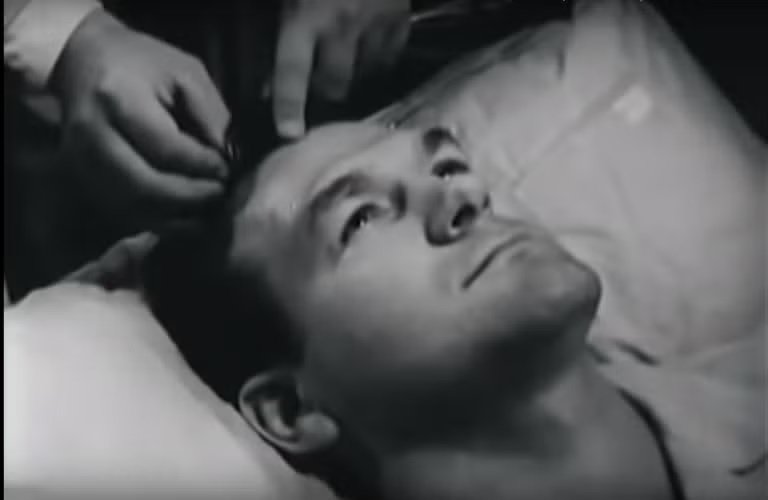
Behind the sealed doors of CIA laboratories, in windowless rooms where sunlight never reached, one of the most terrifying covert operations in human history was taking shape. MK-Ultra was not merely a research program — it was an attempt to break the human spirit and rewrite it, a bloody undertaking that began in the 1950s and continued for decades, leaving behind thousands of victims who lost their minds or their lives in the service of research into “brainwashing.” On April 13, 1953, CIA Director Allen Dulles signed the document that gave the green light for the program to begin. The historical context was the Cold War, and terrifying rumors had spread that the Soviets and Chinese had successfully developed techniques for brainwashing American prisoners of war in Korea. Panic gripped the military leadership, and the decision was made that the United States needed a “mental weapon” that could surpass its adversaries. The chemist Sidney Gottlieb was appointed to head the project — a man known by the nickname the Black Sorcerer for his capacity to devise poisons and torture techniques that left no visible mark on the body while destroying the human psyche from within.
The Structure of the Program and Its Secret Laboratories
MK-Ultra was not a single facility but an octopus-like network comprising more than 149 sub-projects. The agency contracted with 80 institutions, including 44 prestigious universities, public hospitals, prisons, and even orphanages. What was strange and disturbing was that most of these institutions did not know the true nature of the research — funding was channeled to them under the cover of “medical research” through fictitious foundations. The stated objective was to study the effects of drugs on behavior; the real objective was to find a substance or technique that would cause a person to reveal secrets against their will, or carry out an assassination and then forget everything completely. Gottlieb was obsessed with LSD, which had been recently discovered. The agency purchased the entire global supply of the drug and began distributing it to its laboratories. Experiments started with volunteers, but quickly moved to unwilling subjects. Agents placed the drug in the drinks of ordinary people in bars, or abducted homeless individuals from the streets. In one famous operation called Operation Midnight Climax, the agency rented apartments in San Francisco where men were lured under false pretenses, then dosed with high quantities of LSD while intelligence agents observed them from behind one-way mirrors, watching their personalities disintegrate under hallucinations that could last for days.
Dr. Ewen Cameron and the Burning of Minds in Canada
The most horrifying chapter of the program unfolded at the Allan Memorial Institute in Montreal, Canada, under the supervision of psychiatrist Ewen Cameron. Cameron believed he could “empty” the human mind of its existing contents and reprogram it from scratch. His patients — people who had come seeking treatment for minor problems such as anxiety or postpartum depression — were placed in what he called “prolonged sleep,” sedated continuously for periods of up to 65 days. While they slept, speakers hidden beneath their pillows repeated specific phrases thousands of times. When patients woke, they were subjected to electroconvulsive shocks at 30 to 40 times the intensity normally used in psychiatric treatment. The result was that they were reduced to what could only be described as shells — unable to remember their own names or how to use a spoon. Cameron called this process “psychic driving.” He was funded by the CIA through front organizations, and for years the patients he destroyed had no idea that a foreign intelligence agency had financed their treatment.
Hypnosis and the Manchurian Candidate
One of the program’s core ambitions was the creation of what it called the Manchurian Candidate — a programmed assassin who could be activated by a code word or specific signal, would carry out a mission, and would afterward retain no memory of what had occurred. Experiments included attempts to implant multiple personalities within a single individual through deep hypnosis combined with severe pain. A “gap” would be created in consciousness through trauma, and the agency would then attempt to fill that gap with programmed instructions. Some leaked documents indicate that researchers succeeded in inducing certain female subjects to carry out simulated assassination attempts — using unloaded weapons — while in deep hypnotic states, with no awareness of what they were doing. Other experiments focused on total isolation: subjects were placed in tanks of warm water in complete darkness and absolute silence for extended periods, cutting the mind off entirely from the external world. After only a few hours, the mind begins generating terrifying hallucinations to compensate for the absence of sensory input. In this state it is at its most vulnerable, most receptive to any idea introduced into it. These techniques were later adapted and incorporated into the “enhanced interrogation” methods applied by intelligence services in secret facilities around the world.
The 1973 Scandal and the Attempt at Erasure
In the early 1970s the program began to surface after the death of Frank Olson, a chemist working on the project who had been secretly dosed with LSD and fell from a hotel window. As congressional pressure mounted, CIA Director Richard Helms ordered in 1973 that all MK-Ultra files be destroyed. Thousands of documents containing details of victims, physicians’ names, and laboratory findings were burned. The goal was to bury the truth permanently and protect the agency from international criminal prosecution for crimes against humanity. The destruction was not complete, however. In 1977, under the Freedom of Information Act, a collection of financial records that agents had forgotten to destroy was discovered in an archive storage facility. These records revealed enormous funding streams for operations that no one had suspected. Senator Frank Church chaired an investigation committee that exposed the program’s horror to the world for the first time. The agency acknowledged the program’s existence but claimed the results had been “weak” and inconclusive — an assertion that analysts regard as yet another attempt at concealment. If the results had genuinely been failures, the program would not have continued for more than twenty years, and its documents would not have been destroyed with such determination.
The Terrifying Legacy and the Forgotten Victims
To this day, the true number of MK-Ultra’s victims is unknown. Many ended their lives in psychiatric institutions. Others took their own lives. Those who survived carry black holes in their memories where their experiences should be. The program opens terrifying questions that have never been answered: did it truly end, or did it migrate to deeper levels of secrecy and more sophisticated technology? Are the techniques visible today in social media manipulation and the management of public opinion simply the matured descendants of seeds planted by Sidney Gottlieb and his colleagues in those dark rooms? MK-Ultra remains a permanent stain on the history of science — a reminder that human curiosity, when stripped of all ethical constraint, becomes an instrument for the destruction of the very thing it claims to study: the human mind.