
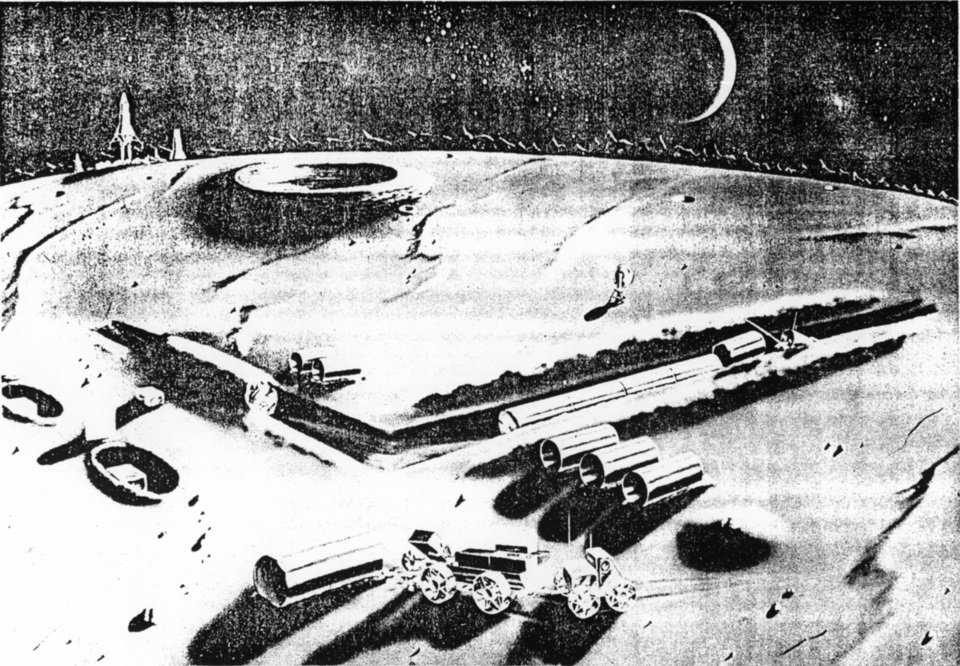
At the height of the Cold War, the Earth was not large enough for the ambitions of the generals in Washington and Moscow. While the world held its breath in fear of imminent nuclear war, a highly classified program called Project Horizon was being developed in secret — a plan to transform the Moon from the celestial body that had inspired poets for millennia into a ballistic missile launch platform and a station for cosmic surveillance. The idea took shape in the late 1950s, and in 1959 the United States Army presented a classified report running to several volumes. The vision it contained was stark and unambiguous: the United States must secure military supremacy over the Moon before the Soviet Union does. The goal was not scientific or exploratory, as NASA would later present its activities to the public. It was purely strategic. Military commanders believed that whoever controlled the “high ground” — in this case the Moon — would control the entire Earth, since any movement on the planet’s surface could be observed with precision and targeted with missiles impossible to intercept.
The Construction Plan for the Base
The project included a precise and alarming timetable. The plan called for launching 147 Saturn rockets to carry equipment and fuel into lunar orbit. By 1965, actual construction of the base was to have begun. This was not to be a facility of tents or simple rooms but an underground complex — built beneath the lunar surface — to protect personnel from cosmic radiation and extreme temperature fluctuations. The design included laboratories, sleeping quarters, and weapons storage, along with a closed system for generating oxygen and recycling water to sustain a military garrison of 12 to 21 soldiers for extended periods. The engineering challenges appeared insurmountable at the time. How does one power a military base in an environment where life cannot exist? The plan called for building small nuclear reactors to be transported and assembled on the Moon. Soldiers would wear highly advanced pressure suits allowing them to perform heavy manual labor constructing lunar tunnels. Most complex was the defense system: special weapons designed to function in a vacuum, since conventional weapons cannot operate effectively in an environment lacking oxygen and terrestrial gravity.
Project A119: The Nuclear Bomb on the Moon
As part of this military obsession with the Moon, a subsidiary project emerged that was even more extreme, known as Project A119. The plan called for detonating a nuclear bomb on the lunar surface — specifically in the terminator zone between light and darkness — so that the entire world, and particularly the Soviet Union, could witness a mushroom cloud rising from the Moon. The goal was to demonstrate power and instill terror in the minds of adversaries. Senior scientists participated in the calculations for this project, among them Carl Sagan, who later revealed these plans publicly. The idea was fortunately abandoned out of concern that irradiating the lunar surface would impede any future colonization. What this episode reveals is the extent to which the Moon had ceased to be a scientific frontier and had become, in the minds of military planners, simply another theater in a global contest for dominance — a high ridge to be seized before the enemy could occupy it.
Absolute Secrecy and the Role of Intelligence
Project Horizon remained tightly classified for decades. The American government had no interest in taxpayers learning that billions were being spent on cosmic military fantasies while cities were suffering acute social crises. The CIA served as the undisclosed overseer of the project’s intelligence dimensions: the plan envisioned placing telescopes and ultrasonic sensing equipment on the lunar surface capable of intercepting wireless communications from anywhere in the world, making the Earth an open book to American eyes. Nothing on the ground could be hidden from an installation at that altitude with that line of sight. The strategic logic was coherent, if frightening: the Moon as a permanent intelligence platform, immune to any countermeasure the Soviets could devise, watching every movement on the surface below in perpetuity.
Why the Project Was Halted
Despite the military enthusiasm, Project Horizon was officially cancelled before the construction phase began. The financial cost was prohibitive even by American defense budget standards — estimated at 6 billion dollars at the time, equivalent to hundreds of billions today. Military commanders also concluded that intercontinental ballistic missiles launched from Earth had become sufficiently accurate and destructive to make a lunar base an expensive redundancy rather than a strategic necessity. The Outer Space Treaty of 1967 then placed a legal nail in the coffin, prohibiting the placement of weapons of mass destruction in orbit or on celestial bodies. The Moon, at least officially, was declared off-limits to the ambitions that had nearly sent soldiers there to build a garrison in the dust.
Buried Secrets and the Claims of the Dark Side
Despite the official cancellation, researchers examining classified archives and former government employees have continued to suggest that Horizon did not die but migrated into undisclosed black programs. Testimonies surface periodically from former NASA or military personnel claiming to have seen images of strange structures or tunnel entrances on the far side of the Moon. Whether these claims have any foundation cannot be verified — the documents that would confirm or deny them remain sealed, destroyed, or were never committed to paper in the first place. The questions they raise are genuine ones: could the technology developed in the 1950s have been quietly deployed? Did the lunar missions that abruptly ceased in the 1970s stop because something was discovered there, or because some undisclosed mission had already been accomplished?
The Mysterious Legacy and the New Race
Today, as the race toward the Moon accelerates again between the United States, China, and Russia, the documents of Project Horizon are surfacing once more. What was considered science fiction or military madness in 1959 has become an openly stated plan for building permanent bases. Horizon stands as a testament to an era when human ambition recognized no ethical or logical boundary, when the Moon appeared to the generals as simply another trench in a world war that never came — but that nearly turned space itself into a nuclear battlefield. The question it leaves open is not whether nations will militarize the Moon, but whether they already have, and whether what we are told about our presence there tells the complete story of what actually happened, and what may still be happening, in the silence between the craters.