
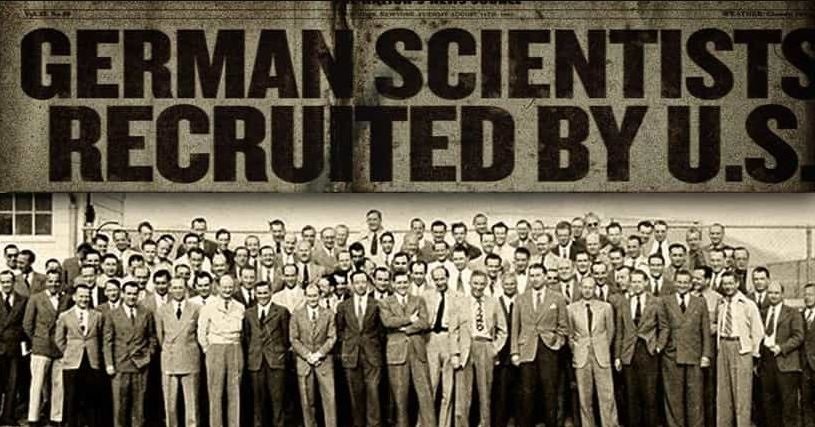
While the fires of World War II were dying out in the streets of Berlin in 1945, a different kind of war had already begun in the corridors behind the scenes. It was not a war of bullets but a frantic race between the Allies and the Soviet Union to seize the minds that had built the Nazi war machine. Operation Paperclip was the secret plan that allowed thousands of scientists and engineers affiliated with the Nazi Party to escape the gallows — becoming instead the cornerstone of American technological and military advancement. As the war drew to a close, American military intelligence recognized that Nazi Germany had been far ahead in the fields of rocketry, chemical weapons, and aviation medicine. The Joint Chiefs of Staff issued a secret order to locate these scientists and secure them before they fell into Soviet hands. A unit called the Exploitation Targets Intelligence Team swept through the ruined German cities searching for a secret document known as the Osenberg List — a record containing the names of senior scientists and technicians who had been working in the fortified Nazi laboratories.
The Origin of the Name and the Circumvention of the Law
The operation was named Paperclip for a simple but revealing reason. American law prohibited entry to anyone proven to have committed war crimes or to have been an active member of the Nazi Party. To circumvent this legal obstacle, intelligence officers placed a paperclip on the files of scientists selected for transfer to America. This paperclip signified that the file had been “sanitized” — biographies were falsified, party memberships erased, prior crimes deleted, so that the subject would appear to American immigration authorities as an innocent technical expert who had suffered under Hitler’s regime. The reality in some cases was that these men had participated in horrifying experiments on human beings. The unspoken slogan was: “If we don’t take them, the Russians will.” This reasoning led to immunity being granted to killers and criminals who had participated in the Holocaust, simply because they possessed mathematical equations or chemical expertise that Washington needed in its struggle with Moscow.
Wernher von Braun: From the V-2 to the Moon
Wernher von Braun is the most prominent figure in the operation. He was the mastermind behind the V-2 rocket that destroyed entire neighborhoods in London. He was not merely a scientist — he was an SS officer. Under his supervision, thousands of prisoners at the Mittelwerk-Dora concentration camp were worked to death building rockets under inhumane conditions. Despite this, von Braun was transferred to the United States, where he became a national hero and director of NASA’s Marshall Space Flight Center — the man without whom Americans could not have reached the Moon aboard the Saturn V rocket. His transformation from SS officer to celebrated space pioneer stands as the most dramatic illustration of what the operation actually accomplished: the laundering of war criminals into national heroes, their crimes erased and replaced with achievements that the country could be proud of.
Aviation Medicine and the Dark Face of Science
The operation was not limited to rocket engineers. It included physicians who had conducted death experiments in the concentration camps. Hubertus Strughold, subsequently honored with the title “Father of Space Medicine,” was among those brought to America through Operation Paperclip. In Germany he had overseen experiments in which prisoners were placed in pressure chambers simulating high altitude until their lungs ruptured, or submerged in tanks of ice water while researchers measured how long they remained alive. The data generated through this torture of human beings was later used to develop American astronaut suits and ejection and survival systems for military aircraft. The prisoners who died producing that data received nothing — not acknowledgment, not justice, not so much as a name recorded in the official history of the space program that their suffering helped make possible.
The Secret Research Centers on American Soil
The German scientists were distributed across classified facilities throughout the United States, including Fort Bliss in Texas and White Sands in New Mexico. They lived in isolated residential compounds with their families, away from the press and the public. Their neighbors believed them to be ordinary European immigrants. In reality they were developing the next generation of intercontinental ballistic missiles and lethal chemical weapons — including the nerve agents Sarin and Tabun, which had been developed by Nazi scientists and were now inherited by the American arsenal. The knowledge transferred was comprehensive and went far beyond rocketry: aerodynamics, high-altitude physiology, chemical warfare, submarine propulsion, and materials science all benefited from what was extracted from Nazi Germany’s research programs through Paperclip.
The Delayed Reckoning
The full details of Operation Paperclip remained highly classified for decades, until documents began surfacing in the 1980s and 1990s and the American public learned that senior officials at NASA and the Department of Defense had once sworn loyalty to Hitler. In 1984, Arthur Rudolph, one of NASA’s chief rocket engineers and a key figure in the Saturn V program, was compelled to renounce his American citizenship and leave the country after his direct involvement in operating slave labor in Nazi underground factories was proven. For thousands of others, however, the reckoning came too late — they died holding American honors and commendations, their files permanently sanitized, their crimes officially nonexistent.
The Contaminated Legacy of Modern Technology
The technology we use today — from GPS navigation to space travel — carries within it what might be called a Nazi inheritance. This is the deepest horror concealed in Operation Paperclip: the possibility that the greatest scientific advances of the twentieth century were built on a foundation of moral catastrophe and on the bodies of thousands of innocent people. The question it leaves in the archive of the unexplained is not merely historical. It is a question about the nature of scientific knowledge itself: can science be considered neutral when its origins are murder and torture? And does a government that grants immunity to war criminals in exchange for useful equations forfeit the moral authority to speak of justice? The answer, buried in those sanitized files, is one that the operation’s architects made sure would never be clearly given.