
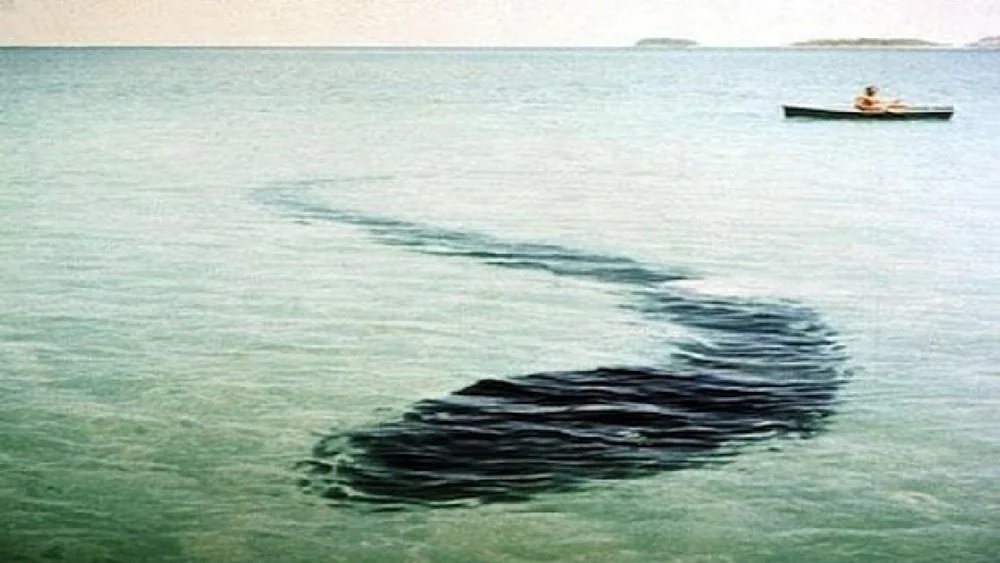
In December 1964, Robert Le Serrec and his family were spending a holiday aboard a boat in Stonehaven Bay off Hook Island, Australia. While navigating the shallow waters, Le Serrec’s wife spotted a massive creature resting on the sea floor. Le Serrec took several photographs showing an enormous black shape resembling a tadpole in its configuration — with a broad head, eyes visible at the upper portion, and a long body tapering to a pointed tail — estimated at approximately 25 meters in length. The creature appeared completely motionless at first.
According to Le Serrec’s account, he and a companion entered the water to photograph it more closely underwater, initially believing the creature might be dead. As they approached, the creature opened its large mouth and began moving slowly, sending both men scrambling back to the boat in terror. It then disappeared into deeper water and was never seen again. The photographs were subsequently examined by various marine biology experts. Some proposed that the object might be a large plastic sheet weighted down with sand, but the witnesses’ detailed descriptions of the eyes, the skin texture, and the movement made a simple dismissal difficult to sustain — at least until further analysis was conducted.
The Scientific Debate
The Hook Island photographs occupy a prominent place in the literature of cryptozoology — the study of creatures whose existence has not been scientifically confirmed. Some researchers have proposed that the creature could represent an undiscovered species of giant shark or sea snake, while others have suggested it might be a surviving specimen of a prehistoric lineage that adapted to deep ocean conditions. The absence of any physical evidence beyond the photographs has kept the case open as a point of debate between those who regard it as a genuine biological encounter and those who see it as a deliberately staged deception produced before the era of digital photo manipulation.
Archive Assessment
The scientific consensus on the Hook Island photographs leans firmly toward deliberate fabrication. The geophysical analysis of Stonehaven Bay indicates that the waters at that location were too shallow to sustain a living creature of 25 meters in length — an animal of that size could not maneuver or remain submerged in such conditions without breaking the surface repeatedly and leaving visible displacement in the sand. The photographic analysis is more decisive: experts in underwater imaging noted that the creature in the photographs shows no volumetric depth beneath the water’s surface. Sand is visible through and beneath the object’s body in ways consistent with a flat material — a cut plastic sheet or heavy fabric — weighted to the bottom, not with a three-dimensional living animal. The placement of the eyes is also inconsistent with the functional anatomy of any known large marine creature.
Marine biologist Ivan T. Sanderson, who examined the case, concluded that the photographs were staged, an assessment supported by subsequent investigation into Le Serrec’s background, which included prior legal proceedings related to fraud. The working conclusion among researchers who have studied the case in detail is that the Hook Island monster was a calculated attempt to profit from photograph sales rather than a genuine encounter with an unknown animal. It belongs in the category of photographic deceptions — skillfully executed for its era, but not evidence of anything that swam in Australian waters in 1964.