
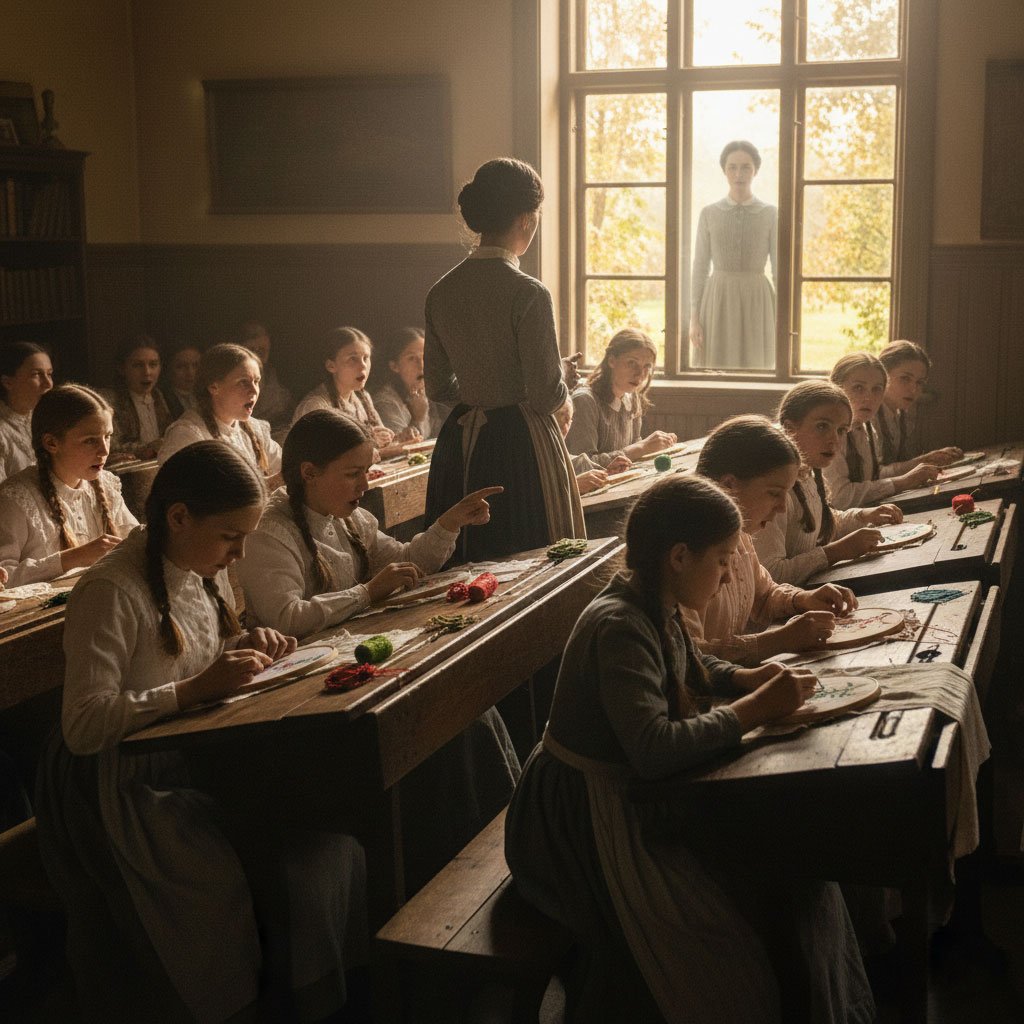
In the autumn of 1845, Emilie Sagée was a young French teacher of thirty-two working at a boarding school for girls in Livonia, then part of the Russian Empire and now Latvia. She was an excellent teacher, well-liked by the students — gentle, patient, educated. But something strange began to happen that sent the girls whispering in the hallways and watching her with unease. One day Emilie was writing on the blackboard in front of a class of thirteen students when all of them saw something that stopped them cold. There were two Emilies — one writing on the board, the other standing beside her making exactly the same movements, a perfect mirror that was nonetheless solid and real. This lasted for a few seconds and then the second figure vanished as though it had never been. The girls screamed in terror. Emilie herself saw nothing and did not understand why they were frightened.
The incidents began repeating almost daily and the number of witnesses grew. Once Emilie was helping a student fasten the back of a dress for a school event, working the buttons from behind, and when the student glanced in the mirror she saw two Emilies — one fastening the dress behind her, the other standing beside her, watching with the same calm expression. The student screamed and fainted, and when she recovered there was only one Emilie. On another occasion the students were having dinner in the large hall with Emilie moving between the tables supervising them. One of the girls glanced toward the window and saw Emilie in the garden picking flowers — but when she turned back, Emilie was standing inside the hall only a few meters away. She was in two completely different places at the same moment, and dozens of girls saw both of her simultaneously.
The Day Witnessed by 42 Students
The most extensively documented incident occurred on a summer day when all forty-two students of the school were gathered in a large hall learning embroidery and sewing. Emilie was supervising them, moving among them, and then sat down in a chair at the front of the hall to watch them work. Through the hall’s large windows the school garden was visible, where the other teachers were cutting flowers. Suddenly the girls began whispering and pointing toward the window. Emilie was in the garden picking flowers with the other teachers — but when they looked toward the front of the hall, Emilie was still sitting in the chair in exactly the same position, motionless. Forty-two girls saw two versions of Emilie Sagée simultaneously: one in the garden, one in the hall. Several of the braver students approached the chair and touched the seated figure. It was solid but strange — like dense fog, one described it — and when one girl tried to move her hand through it she felt mild resistance, as though pushing through thick air. The two versions persisted for several minutes, then the seated figure began slowly dissolving until it disappeared completely.
When the real Emilie returned from the garden half an hour later and the students asked what had happened, she said she had been in the garden the entire time and had never been in the hall. But she admitted something strange: while she was in the garden she had briefly thought that she should be in the hall with the students, that they were alone and might need supervision. A passing thought — but apparently sufficient to create a complete physical copy of herself in the place she had been thinking of. This was the most disturbing element of the entire story: the second figure was not merely a vision or a hallucination but was somehow connected to Emilie’s thoughts and intentions.
The Hidden Professional History
After the large incident, parents began withdrawing their daughters from the school. Within weeks enrollment had dropped sharply and the headmistress was forced to dismiss Emilie, despite the fact that she was an excellent teacher who had done nothing wrong. Emilie accepted the dismissal quietly and sadly and left without protest. But what was discovered afterward was stranger still. When the headmistress investigated Emilie’s professional background, she found that this had been Emilie’s nineteenth position, and that she had been dismissed from every previous post for exactly the same reason. At every school she had worked in, the same phenomenon had begun occurring after a few months, the same witnesses seeing her in two places at once, and each time she had been let go because of the panic among students and parents. Nineteen institutions across years, the same strange story repeating each time. The records do not document what became of Emilie after this. Some sources indicate she disappeared entirely from official records after 1846, with no information on her death or burial. Perhaps she changed her name or moved somewhere no one knew her. Perhaps she spent the rest of her life in complete isolation to avoid terrifying those around her.
The Testimony That Reached Us Fifty Years Later
The story might have been entirely forgotten had it not been documented in detail by Robert Dale Owen, a prominent American researcher into paranormal phenomena, in his 1860 book Footfalls on the Boundary of Another World. Owen obtained the account from one of the students who had been at the school and witnessed the incidents firsthand — Julie von Guldenstubbe, daughter of a Latvian nobleman, who had become a respected and prominent woman in society. She recounted to him in full detail everything she had seen, including the incident witnessed by all forty-two students. She said that even fifty years later she remembered with complete clarity the moment of seeing two Emilies, and the moment of touching the phantom figure that was solid and smooth and strange all at once. Owen was a careful researcher who did not accept accounts without investigation. He contacted other surviving students from the same school, and all confirmed the same story with the same details. Some were still living in the 1860s and wrote him detailed letters about what they had witnessed. There were no significant contradictions among the testimonies — which is extremely rare in accounts of paranormal phenomena. This consistency across different witnesses separated by decades made the Sagée case one of the most thoroughly documented doppelganger incidents in history.
The Phenomenon Without Explanation
The doppelganger — one’s double — is well-known in European folklore, traditionally regarded as an omen of death or misfortune. But Emilie’s case was fundamentally different because the witnesses were not herself but dozens of unconnected individuals, and because the phenomenon repeated hundreds of times across years in nineteen separate locations with entirely different witness populations. Modern science has no framework for this. It contradicts everything known about physical reality and the properties of matter. Some researchers have proposed that it represents a rare case of involuntary astral projection, in which a person’s etheric body exits and becomes visible to others — but this is speculation without mechanism. Others have suggested some form of quantum consciousness effect in which focused intention can produce a physical copy of the body elsewhere, pointing to Emilie’s own admission that she had been thinking of the hall while in the garden. But we have no known physical mechanism that permits this. The simplest explanation — collective hallucination — cannot account for forty-two people simultaneously experiencing the same detailed vision, or for the phenomenon persisting across nineteen institutions with no overlap in the witness population.
The Woman Who Lived Two Lives
Emilie Sagée was an ordinary woman who did not ask to be strange. She was not a mystic or a fraud or someone seeking attention — she was a simple teacher who wanted only to live a normal life. But something in her body or her consciousness or her presence created copies of her without her will and without her control, and it destroyed her professional life and likely everything else. She was condemned to solitude because anyone who came close to her would eventually see the second version and flee in terror. No one knows where Emilie Sagée died, or when, or how. No one knows whether the second figure continued appearing until the end of her life or faded at some point. No one knows whether there were other women throughout history who experienced the same phenomenon whose stories were simply never recorded. Forty-two girls saw something impossible, touched it with their hands, and spent the rest of their lives knowing that what they had seen was real — even as the world insisted it could not be. And that, perhaps, is the most unsettling element of the story: not the phenomenon itself, but the certainty of those who witnessed it.