
Somewhere between physics and philosophy lives a question that has gone unanswered since the dawn of human thought: what is consciousness? This moment of awareness, the feeling that you “exist,” the subjective experience you live every second — where does it come from? Is it merely a byproduct of electrical activity in your brain, the way a sound is produced by burning fuel in an engine? Or is it something far deeper, something connected to the fundamental fabric of the universe itself? For centuries, philosophers have attempted to answer. Descartes said “I think, therefore I am,” but he did not explain how the thinking happens. Contemporary neuroscientists study the brain, watch neurons fire their electrical signals, map the regions responsible for memory and emotion and movement. But no one can point to a specific location in the brain and say: “Here is where consciousness lives.” The hardest problem — what philosophers call the “hard problem of consciousness” — is this: how do physical processes (electrical activity, chemical reactions) become subjective experience? How does neural activity in your brain become the feeling of a rose’s redness, the taste of coffee, the pain of loss?
In the 1990s, two of the most unconventional minds in science proposed a theory that shocked the field. The first was Roger Penrose — the British mathematical physicist who received the Nobel Prize in Physics in 2020 for his work on black holes, a genius so formidable that Stephen Hawking himself collaborated with him for decades, responsible for revolutionary theories in mathematics and physics. The second was Stuart Hameroff, the American anesthesiologist who had spent decades trying to understand how anesthetic drugs erase consciousness entirely. What they proposed together was this: your consciousness is not merely complex biological computation. Your brain is not a conventional computer, as most scientists assume. It is a quantum machine, operating according to the strange laws of quantum mechanics and interacting with reality at a level we do not yet understand. And if they are right, everything we think we know about consciousness, the mind, artificial intelligence, and death may be completely wrong.
Why a Mathematical Genius Decided to Study Consciousness
In 1989, Roger Penrose published a book called The Emperor’s New Mind, in which he made a bold claim that stunned the scientific community: human consciousness is non-computational. In other words, no computer, no matter how powerful, can be genuinely conscious. Artificial intelligence, no matter how advanced, will remain a simulation — a sophisticated imitation — but will never experience genuine subjective experience. Penrose’s argument was complex and controversial. He drew on Gödel’s incompleteness theorem, which states that any sufficiently powerful mathematical system will always contain true statements that cannot be proved within the system itself. Penrose argued that the human mind can perceive these unprovable truths, and therefore does something that goes beyond pure algorithmic computation. Humans can “jump” outside the system, see the larger picture, grasp intuitive truths that cannot be logically derived. Machines cannot. But if consciousness is non-computational, what is it? Penrose proposed that it might be a quantum phenomenon — that somewhere inside the brain, quantum processes occur: superposition states, quantum entanglement, the collapse of wave functions — and that these processes are the foundation of consciousness.
Microtubules: The Discovery That Changed Everything
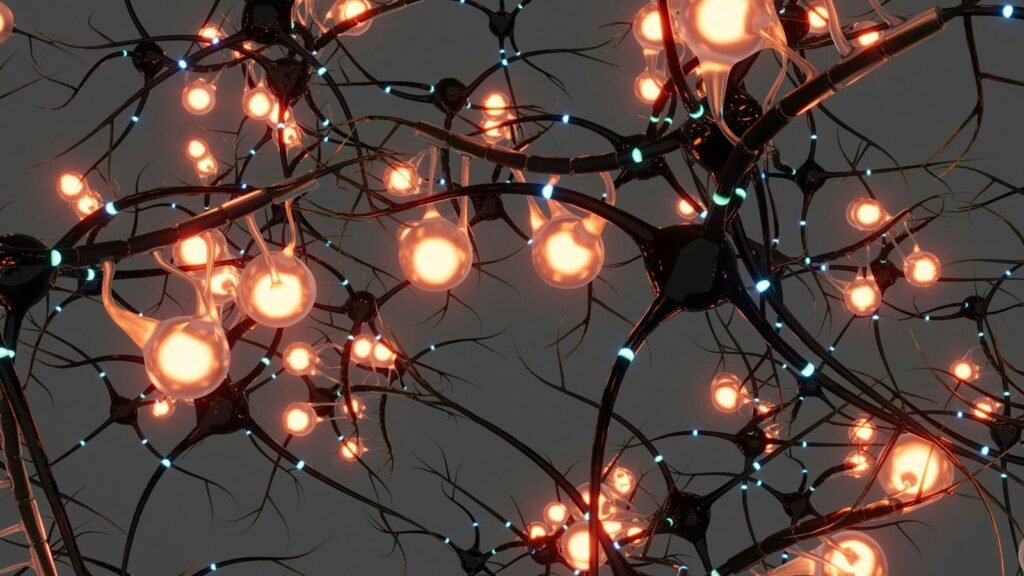
At roughly the same time, in Arizona, Stuart Hameroff was confronting a different puzzle. As an anesthesiologist, he witnessed daily a mysterious phenomenon: a simple chemical molecule enters the bloodstream, and suddenly consciousness switches off entirely. The patient stops feeling, stops perceiving, stops subjectively existing. Then, when the substance clears, consciousness returns. The drugs do not disable the brain entirely — basic functions continue, the heart beats, the lungs breathe, some neural responses remain active. But consciousness, that subjective experience of being, vanishes completely. Hameroff was focused on tiny structures inside neurons called microtubules: hollow cylindrical structures approximately 25 nanometers in diameter, composed of proteins called tubulin, previously known to play roles in cell structure and division. He suspected they had a deeper function. Then he read Penrose’s book. Suddenly everything fit. Microtubules could be the site where quantum processes occur — Penrose had been searching for a biological mechanism, and Hameroff had one. They began a collaboration that lasted decades, and in 1994 Penrose published a second book, Shadows of the Mind, presenting their joint theory: Orchestrated Objective Reduction, known as Orch-OR.
How the Theory Works: Quantum Mechanics Inside Your Brain
The core idea of Orch-OR can be simplified. Inside the microtubules of neurons, tubulin proteins enter quantum superposition states — each protein can exist in two different states simultaneously, like Schrödinger’s famous cat that is both alive and dead at once. These superposed states are not random. They are “orchestrated” — linked through quantum entanglement, forming a coherent pattern across thousands or even millions of tubulin proteins in multiple microtubules throughout the brain. This coherent quantum pattern is what Penrose and Hameroff call a “pre-conscious state” — parallel quantum computations exploring multiple possibilities simultaneously. Then, at a critical moment, “objective reduction” occurs. This is not an ordinary quantum wave function collapse of the kind that happens during measurement in physics experiments. Penrose proposes something deeper: a collapse caused by quantum gravity. When the mass-energy difference of the superposed states reaches a certain threshold related to the curvature of spacetime, nature itself “decides” that the superposition cannot continue, and it collapses into a single classical state. And this collapse, according to Penrose and Hameroff, is the moment of consciousness. In that specific instant, the brain transitions from “exploring quantum possibilities” to “making a conscious decision.” The quantum superposition becomes a clear thought, a decision, a perception. Consciousness is not the result of neural activity — it is a moment of quantum collapse.
The most striking implication: if this is true, your consciousness is not confined to your skull. It is entangled with the fabric of spacetime itself, with gravity, with the fundamental structure of reality. Every thought you think is in fact a subtle cosmic event — an interaction between matter and spacetime at the quantum level.
The Disturbing Evidence: Why the Theory Cannot Be Dismissed
Orch-OR attempts to explain real phenomena that conventional science cannot account for. The quantum measurement puzzle: in the famous double-slit experiment, electrons behave as waves when unobserved, passing through both slits simultaneously and producing an interference pattern — but when a detector monitors which slit they pass through, they behave as particles, each passing through only one slit, and the interference pattern disappears. The electrons seem to “know” they are being watched. The prevailing Copenhagen interpretation says that “measurement” causes wave function collapse, but leaves open the question of what measurement requires. Physicist Eugene Wigner argued that consciousness is necessary for wave function collapse. Penrose holds a similar view. The anesthesia puzzle: different anesthetic molecules have completely different chemical structures, yet all erase consciousness by the same mechanism. Hameroff proposes they all bind to specific sites on tubulin proteins in the microtubules, disrupting quantum entanglement — without entanglement, no coherent quantum state, and therefore no consciousness. Near-death experience: people in clinical brain death, with no measurable neural activity on EEG, report conscious experiences and accurately describe events that occurred in the operating room during cardiac arrest — conversations, precise details, things they could not otherwise have known. Conventional theory cannot explain how consciousness exists without brain activity. If consciousness is quantum and entangled with the fabric of the universe, it may not require an active brain to persist briefly. The free will problem: if the brain is purely computational, all decisions are deterministic outcomes of physical laws. But if consciousness is quantum and non-computational, genuine free will may exist — the capacity to “jump” outside the deterministic system.
The Fierce Opposition: Why Most Scientists Reject the Theory
The central objection is thermodynamic. Quantum superposition states are extremely fragile. Any interaction with the surrounding environment — heat, moisture, vibrations — causes decoherence, immediately collapsing the quantum state into a classical one. To protect quantum states in laboratories, physicists use environments cooled to near absolute zero, completely isolated from external interference. The brain is the opposite: 37 degrees Celsius, an aqueous environment, continuous molecular vibrations, loud electrical activity — every condition that destroys quantum entanglement. In 2000, physicist Max Tegmark of MIT published a calculation of how long quantum entanglement could survive in microtubules. His result: approximately 10⁻¹³ seconds — a fraction of ten trillionths of a second. He wrote, with some irony, that for his thoughts to correspond to quantum computations, they would need to conclude before decoherence begins, which would require thinking fast enough to produce ten trillion thoughts per second. Penrose and Hameroff responded that Tegmark’s calculation assumes an oversimplified model and does not account for possible protective factors. The debate remains unresolved. Stephen Hawking, despite decades of collaboration with Penrose on theoretical physics, was openly skeptical of quantum consciousness theory, believing consciousness would ultimately be explained biologically without quantum mechanics. The philosophical objection is also serious: Penrose’s argument from Gödel’s theorem has been challenged by philosophers of mathematics who note that human mathematicians are not logically consistent — we believe false things, commit logical errors, and our actual mathematical practice involves trial, error, intuition, and inspiration, none of which necessarily implies we are non-computational.
The Evidence That Has Kept the Theory Alive
Despite sustained criticism, Orch-OR has not been refuted. Quantum effects have been discovered in biological systems previously assumed too warm and wet to support them: photosynthesis in plants uses quantum entanglement to transfer energy with remarkable efficiency, bird navigation may rely on quantum entanglement in the eye’s retina for sensing the earth’s magnetic field, and research suggests molecular smell detection may depend on quantum vibrations. A 2013 Japanese study found quantum vibrations in microtubules at specific frequencies — not proof of Orch-OR, but consistent with the possibility that microtubules can support quantum processes. A 2022 experiment conducted under Gran Sasso mountain in Italy tested part of Penrose’s theory — the idea that gravity causes wave function collapse. Results were inconclusive: the experiment ruled out the simplest gravity-based collapse models, but found that more complex models (which Penrose prefers) remain possible. Penrose and Hameroff took this as evidence that the theory has not been falsified, only that more precise experiments are needed. In 2017 Penrose launched the Penrose Institute for the study of human consciousness through physics, indicating that after decades of criticism, he remains convinced that consciousness is a non-computational quantum phenomenon.
If the Theory Is Correct: The Implications
If Orch-OR is right, the consequences for our understanding of reality are enormous. Consciousness would not be local — not confined to the brain but an event occurring in the fabric of spacetime itself. In quantum mechanics, information is never destroyed (the quantum information conservation principle), which means that if consciousness consists of quantum information entangled with the universe, the question of what happens to it at death becomes genuinely open. Penrose has not claimed there is an afterlife, but the theory creates philosophical space for the question in a way that pure neuroscience does not. If consciousness is necessary for wave function collapse, then we are not merely discovering reality — we are participating in its creation. The quantum universe is an ocean of probabilities, and consciousness is what makes a specific probability “real.” And if Penrose is right that consciousness is non-computational, then no classical computer, regardless of power, can ever be genuinely conscious. Current AI systems, however sophisticated, would remain intelligent simulations without subjective experience — consciousness would remain exclusive to biological systems, or at least to systems capable of the specific kind of quantum computation that biology, apparently, has been quietly doing all along.
The Questions Without Answers
Orch-OR is not accepted science. It may never be. Most neuroscientists consider it on the margins of the field, and many physicists regard it as untestable speculation. Even its supporters acknowledge it remains a proposal more than a complete theory. But it raises questions that cannot be ignored, and it attempts to account for phenomena that conventional science has not been able to explain. Perhaps Penrose and Hameroff are wrong, and consciousness will eventually be fully explained by conventional neuroscience as we understand the brain better. Perhaps quantum entanglement in the brain is genuinely impossible due to rapid decoherence. Perhaps the argument from Gödel does not prove what Penrose thinks it proves. But until that explanation arrives — until someone can point to a mechanism that transforms electrical signals into the redness of red, the sound of a name, the weight of grief — the hard problem of consciousness remains genuinely hard. And the possibility that the answer lies not in the biology of the brain but in the quantum structure of spacetime itself remains, at minimum, one of the most interesting ideas in contemporary science: that every moment of awareness you have ever experienced is not a byproduct of chemistry, but a small event in the universe becoming, briefly, aware of itself.