
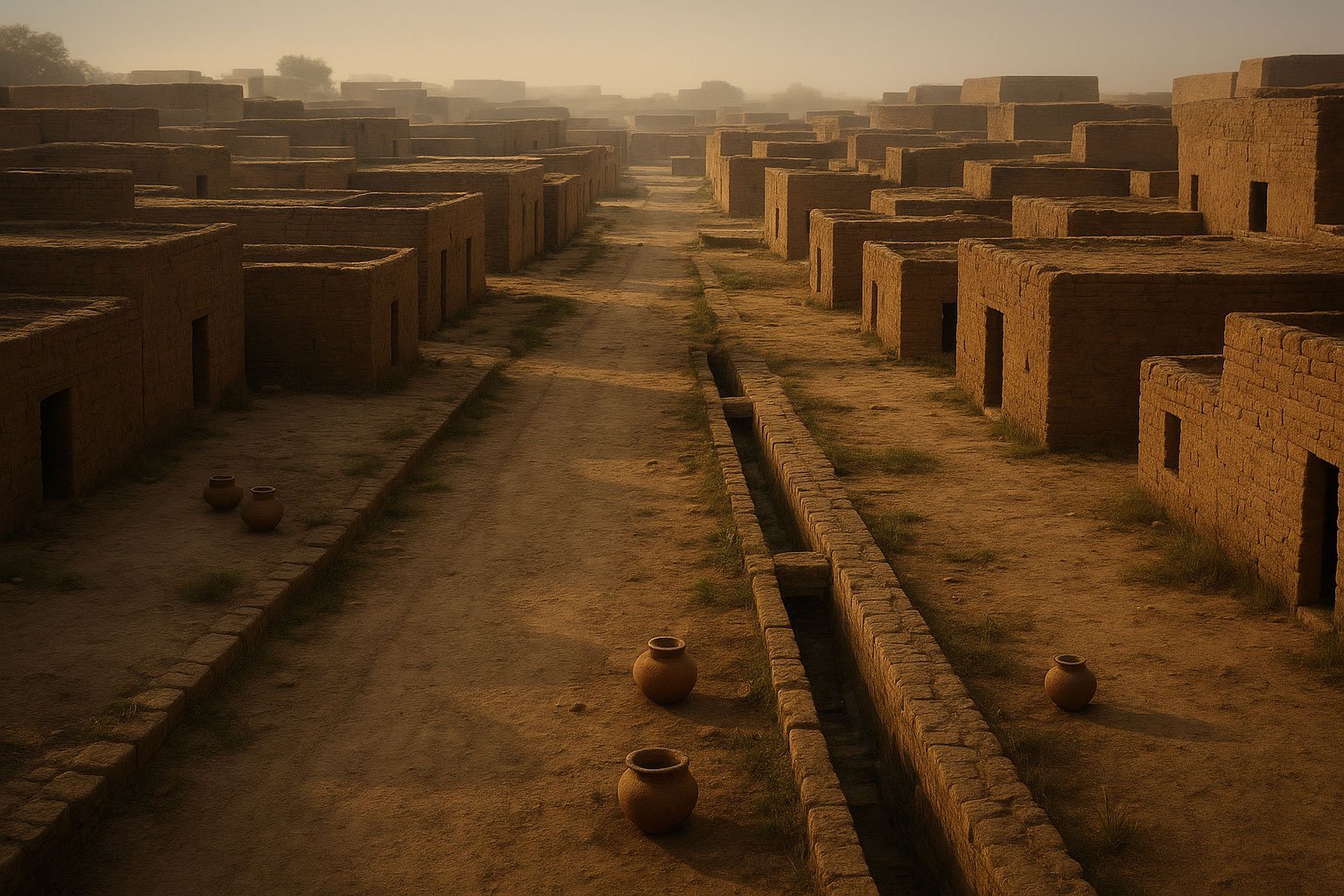
The ruins of Mohenjo-daro — a name that translates from the Sindhi as “Mound of the Dead” — lie at coordinates 27.3295° North and 68.1389° East, in the Larkana district of Sindh, Pakistan, rising above a vast floodplain historically fed by the Indus River. The city was not built on natural high ground. Its builders constructed it on massive artificial platforms of mud-brick and compacted earth specifically to withstand the region’s recurring seasonal floods, raising the entire city approximately twelve meters above the surrounding plain. The total area of the excavated site reaches around 300 hectares, making Mohenjo-daro one of the largest urban concentrations in the ancient world at its peak around 2500 BCE — a city whose scale alone demands explanation, and whose end demands it even more urgently.
The Operational Engineering of the Grid System
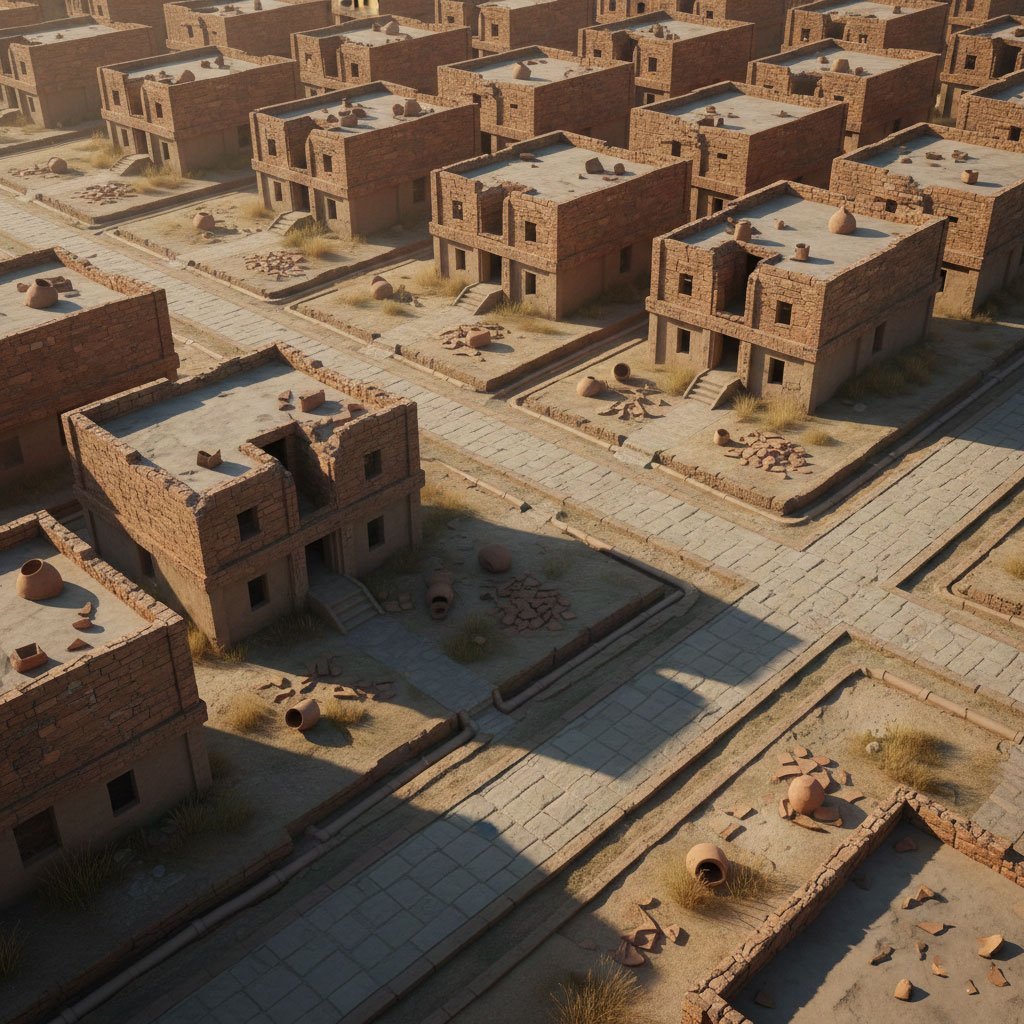
Mohenjo-daro stands as the earliest documented historical model of strict grid-based urban planning. The city was divided into two functional zones: the Citadel to the west and the Lower Town to the east. The principal streets running north-to-south and east-to-west measured approximately 9.1 meters wide — wide enough to allow two ox-drawn carts to pass side by side. Every street intersection met at a precise right angle of 90 degrees, indicating the existence of a central planning authority equipped with sophisticated measurement instruments. Among the most operationally remarkable details of the site is the absolute standardization of building bricks across the entire civilization: every fired brick was produced to a fixed ratio of 4:2:1 — the optimal ratio for structural interlocking — and this identical standard was applied across thousands of structures spanning more than one million square kilometers of the civilization’s known influence. This is not coincidence. It is protocol.
Hydraulic Infrastructure: The Great Bath and the Purification Network
The Great Bath is the most prominent operational structure within the Citadel — a rectangular pool measuring 11.88 by 7.01 meters, with a depth of 2.44 meters. Its construction reflects a level of hydraulic engineering that should not exist at this point in human history. Bricks were laid with extraordinary precision along the edges, and a thick layer of natural bitumen was applied to prevent water seepage — one of the earliest documented waterproofing operations in recorded history. The pool was supplied by water from an adjacent large well and drained through a spiral channel leading into the city’s main drainage network. It was not decorative. It was an operational facility, most likely serving organized ritual purification or collective ceremonial use on a civic scale. The sophistication of that single structure, considered against its era, remains unexplained.
The city’s underground sanitation network surpasses, in its operational precision, the drainage systems found in European cities of the medieval period. Nearly every house in Mohenjo-daro had its own toilet and bathroom, connected by inclined ceramic pipes to the street drains in a design that used gravity flow to ensure continuous movement of waste. Covered inspection chambers — fitted with stone slabs that could be lifted for periodic maintenance and blockage removal — were built throughout the network, indicating the existence of a dedicated municipal body responsible for environmental management. All drains were covered with fired brick, preventing the spread of odor and disease in a design that reflects a public health consciousness not replicated at civilizational scale until thousands of years later.
The Commodity Economy and the Precise Weights System
Excavations have uncovered a standardized weights and measures system of a precision that continues to unsettle researchers. Cubic weights carved from chert stone follow a binary progression — 1, 2, 4, 8, 16, 32, scaling up to 12,800 units — with a base unit weighing approximately 0.856 grams. This operational standardization of weights, applied consistently across hundreds of cities, points to a cross-border trade network operating on strict accounting protocols. It explains the city’s evident prosperity without requiring any visible army to enforce compliance. The civilization did not project power through soldiers. It projected it through measurement.
The Mystery of the Thermal Traces: A Forensic Analysis of the Destruction
Despite the city’s outwardly peaceful archaeological profile, a set of findings — scientifically contested but documented — points toward something far more disturbing in Mohenjo-daro’s final hours. In certain areas of the site, archaeologists have reported the discovery of vitrified soil: layers of earth and brick fused and glassified by exposure to temperatures exceeding 1,500 degrees Celsius over an extremely brief period of time. Blocks of brick were found melted and petrified together in a way that no conventional fire, no kiln, and no known Bronze Age military technology can produce. These are not burn marks. They are structural transformations of the material itself, caused by heat of a kind and speed that the archaeological record of this era has no category for.
In certain streets — including the area known as the House of the Priest — scattered skeletal remains were found in positions suggesting sudden, instantaneous death. One grouping showed an entire family, hands clasped together, collapsed in the middle of the street. There were no weapons nearby, no sword wounds on the bones, no evidence of a battle. The bodies were not buried. They were abandoned precisely where they fell, as if no one survived to bury them — or as if whatever happened left no time for anything at all. These findings have generated hypotheses about a sudden thermal event or an instantaneous environmental catastrophe that gave the population no window for flight. No consensus explanation has emerged. The thermal evidence remains what researchers call a data gap in the conventional archaeological record: heat signatures that do not correspond to any siege technology, any volcanic event, or any fire pattern known from the Bronze Age.
The Lost Linguistic Record: The Seals That Cannot Be Read
More than 2,000 stone seals have been extracted from the site, each carved with precision depicting animals — rhinoceros, elephant, bull — accompanied by inscriptions ranging from four to twenty-six symbols. Every computational attempt to decode this script, including analysis by modern supercomputers, has failed. The absence of long texts — no epics, no royal records, no administrative archives — suggests that writing in this civilization served a purely operational function: shipping labels, ownership marks, trade seals. The civilization left no voice behind. When its merchants disappeared, its language disappeared with them, sealed inside objects that the entire accumulated intelligence of modern scholarship has not yet learned to open.
What “Mystery Archive” Reads Between the Lines
The field evidence from Mohenjo-daro points to several operational conclusions that go beyond conventional interpretation. The city’s hydraulic infrastructure — extraordinary in its complexity and precision — was also the source of its structural vulnerability. Any significant shift in the course of the Indus River would have caused a cascading blockage throughout the underground network, converting the city’s greatest engineering achievement into an environmental catastrophe from within. A system built for stability had no mechanism for adaptation when the river it depended on moved. The very sophistication that made Mohenjo-daro exceptional made it brittle.
The rigid standardization of brick dimensions, weights, and urban layouts across vast distances also reveals an administrative system so centralized that it lacked local flexibility. When systems of this kind face sudden crises, they do not adapt — they collapse in sequence. The failure of the administrative center would have triggered a domino effect across every dependent settlement operating on the same operational protocol, with no local authority capable of improvising a response. And the vitrified brick layers and unburied skeletal clusters introduce a possibility the archaeological establishment has not resolved: that the city’s end involved a thermal event of a kind and speed that Bronze Age civilization cannot account for — one that left no carbon traces, only physically altered earth, and bodies frozen in the postures of people who had no warning at all. The disappearance of the Indus Valley Civilization ultimately represents a model of systemic dissolution: infrastructure did not collapse under external force, but the administrative operations that kept the infrastructure functioning simply stopped — and without those operations, the cities became elaborate stone structures waiting to be swallowed by the plain.