
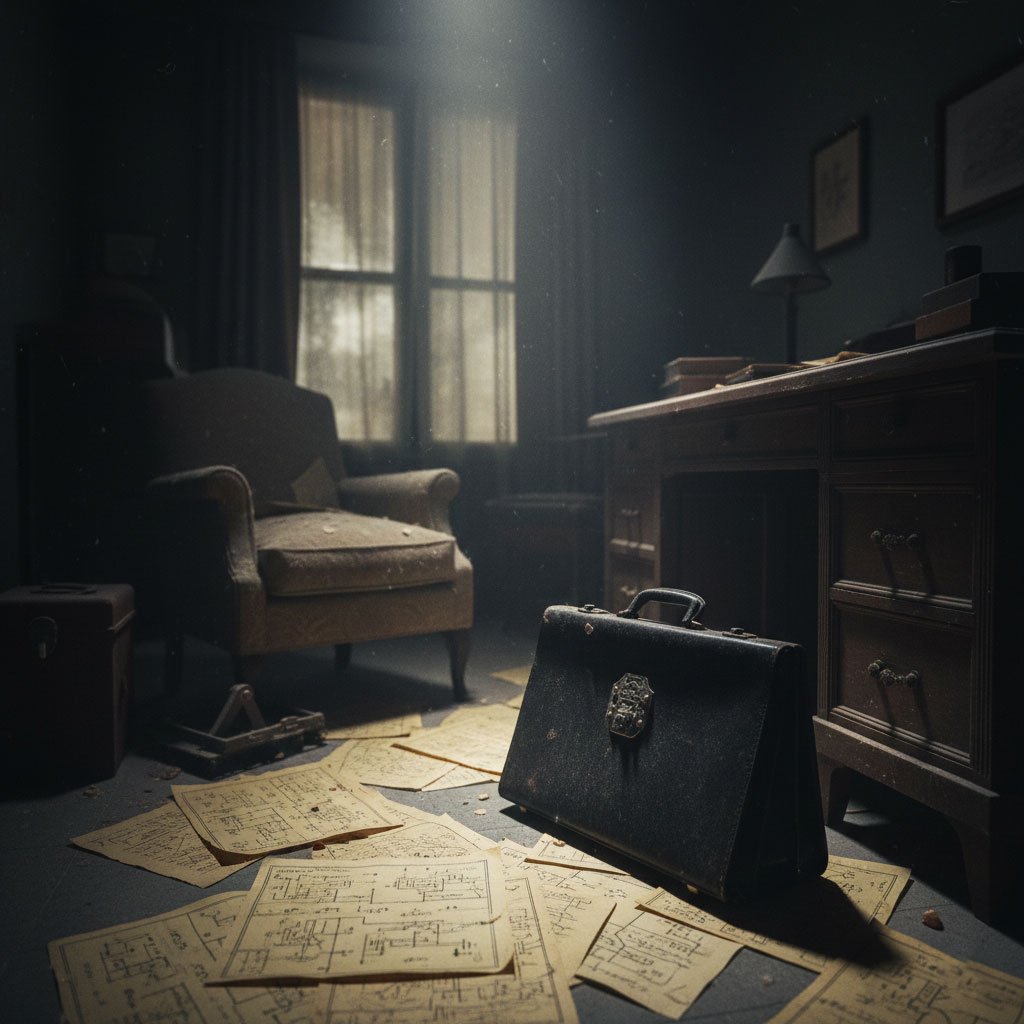
In the autumn of 1943, the American inventor Nikola Tesla lay on a narrow bed in room 3327 of the New Yorker Hotel — alone, penniless, and forgotten after decades of fame, fortune, and ruin. He was 86 years old, living on the hotel management’s sufferance since he had not paid rent in years. On the morning of January 8th, a chambermaid found him dead in his bed. On the desk beside him lay scattered papers, files, and technical drawings, along with a black leather briefcase sealed with an intricate metal lock. Within hours of the death announcement, agents from the Federal Bureau of Investigation arrived, sealed the room, and refused entry to anyone. They proceeded to collect every sheet of paper, every notebook, every diagram, and every photograph, packing them into cardboard boxes stamped “Top Secret — National Security.” The black leather briefcase disappeared entirely and was never mentioned in any official report that followed.
The question that has confounded historians ever since is a simple one: why would the United States government take such urgent interest in the papers of a bankrupt, forgotten inventor who died in a cheap hotel room? The official explanation was that Tesla had worked on classified military projects during the First World War and that his documents might contain sensitive material. But researchers who examined the partially declassified files decades later found something far stranger — Tesla had been working, until his final days, on an invention he described in a letter to an old friend as something that “will change the concept of war and peace forever” and “the most dangerous thing man has built since the discovery of fire.” The project carried an unusual name: the Death Ray, or as Tesla himself called it, Teleforce.
The Impossible Invention
According to the limited documents later released, Tesla had been developing a device capable of projecting a beam of charged particles with enormous force across hundreds of kilometers — capable, he claimed, of bringing down aircraft, destroying entire armies, and reducing cities to ash. The device, by Tesla’s own description, required no conventional fuel but drew its energy directly from Earth’s ionosphere, a claim that most scientists of the era dismissed as pure science fiction. But Tesla was no idle dreamer. He was the engineer who invented alternating current and the electrical power system that still illuminates the world today — a man who held more than three hundred patents across multiple fields. In 1934, nine years before his death, he held a press conference announcing that he had completed the design for the Death Ray and had presented it to the American government, which rejected it as impractical. He then attempted to sell the project to the Soviet Union, Britain, and Yugoslavia. Every government passed.
The contradiction is difficult to overlook: the same American government that dismissed the project as fantasy in 1934 dispatched FBI agents to seize every last one of his papers the moment he died nine years later. After collection, the documents were transferred to the Office of Alien Property — a wartime government division that handled the assets of foreign nationals — despite the fact that Tesla had been an American citizen since 1891. Dr. John Trump, a physicist from the Massachusetts Institute of Technology, was assigned to examine the papers and produced a fourteen-page report concluding that Tesla’s ideas were largely “speculative, philosophical, and impractical” and that “there are no new principles or methods of significant value.” The report reassured the public — but eighty pages of the original file had been removed entirely from the published version and remain classified to this day.
The Mysterious Disappearance
Ten days after Tesla’s death, his nephew Sava Kosanović — his sole heir — vanished from New York. Kosanović was a Yugoslav diplomat and the last person known to have seen Tesla alive, visiting him two days before his death. According to Kosanović’s own account, Tesla told him that “the final blueprints for the most important project of his life are stored in a safe place, to be delivered to a specific person only after his death.” Kosanović then disappeared from New York without explanation for weeks, and when he finally surfaced in Washington, he refused to discuss Tesla or his own whereabouts and immediately requested transfer back to Yugoslavia. More strangely still, when he arrived in Belgrade two months later, he was carrying a small metal box he refused to open at customs, claiming it contained “his uncle’s ashes” — despite the fact that Tesla’s ashes were already documented as remaining in New York. That small metal box exists today in the Nikola Tesla Museum in Belgrade. It has never been opened. No one knows what it contains.
In 1952, nine years after Tesla’s death, the American government returned all confiscated papers to Yugoslavia in a single shipment — eighty large wooden crates transported to Belgrade. When researchers opened the crates, they found that hundreds of pages were missing entirely. Tesla had numbered his papers by hand, and entire sequential sections were absent, particularly from the files relating to Teleforce and wireless energy transmission. The museum’s director at the time wrote a formal letter to the American government requesting the missing pages. The response was unambiguous: “No additional documents are in our possession.” Where those hundreds of pages went — and whether they contained the complete blueprints for the Death Ray — has never been answered.
The Troubling Evidence
Beginning in the 1970s, declassified government documents began surfacing that referenced a highly classified military program called Project Seesaw, whose stated objective was the development of a charged-particle beam weapon — precisely the technology Tesla had described decades earlier. The project received substantial funding throughout the 1940s and 1950s before abruptly terminating in 1959 with no official explanation. Some researchers believe the project succeeded but was concealed for security reasons, and that Tesla’s ideas were never as impractical as Dr. Trump’s report implied. What makes this particularly unsettling is that Trump himself — the man who examined Tesla’s papers and declared them worthless — later became a senior advisor to the American nuclear weapons program, worked on radar technology development during the Second World War, and received high-level government commendations. The possibility that his report on Tesla’s papers was deliberate misdirection has never been formally investigated.
In 1984, a small item appeared in an interior page of The New York Times noting that President Ronald Reagan had announced an ambitious defense initiative — the Strategic Defense Initiative, or SDI, popularly known as “Star Wars” — aimed at developing laser and particle-beam weapons to intercept Soviet missiles from space. The program received hundreds of billions of dollars in funding across multiple decades. Although the government publicly declared it a failure and shut it down in 1993, independent researchers examining leaked military documents found references suggesting that certain components of the program continued operating in secret under different program designations. The question that follows is unavoidable: were Tesla’s missing blueprints the foundation for a technology on which governments spent hundreds of billions of dollars?
The Buried Secret
Today, more than eighty years after Tesla’s death, thousands of pages of his papers remain classified and held in the vaults of American intelligence agencies, inaccessible to researchers. In 2016, the Tesla Science Foundation submitted a formal Freedom of Information Act request for the complete files. The response stated that “release of these documents could damage the national security of the United States.” How the papers of an inventor who died in 1943 could constitute a national security threat eight decades later has never been explained. Adding to the strangeness, the small metal box in the Belgrade museum — officially described as containing Tesla’s ashes — has been analyzed using X-ray imaging, which shows it contains folded papers, not ash. The Serbian government refuses to open it or permit examination of its contents, citing “respect for the wishes of the deceased.”
In memoirs published after his death in 1985, Dr. John Trump included a single cryptic passage about his examination of Tesla’s papers. He wrote: “There was one thing in those papers that cost me weeks of sleep, but I cannot speak of it even in my private memoirs.” He then crossed the sentence out in black ink — but the words remain legible beneath the strikethrough. What did Dr. Trump see in those papers? Was the Death Ray real, or was there something in those files more disturbing than a particle-beam weapon? Does Tesla’s final invention sit today in a classified government vault, or was it destroyed out of fear of its destructive potential — or, the possibility that carries the most weight, is it being used right now in military programs the public knows nothing about?
The Riddle That Will Not Die
The questions compound the deeper the record is examined. Why did Sava Kosanović disappear for weeks following the death, and why did he refuse to discuss that period until his own death in 1969? Why does the black leather briefcase — observed by multiple witnesses in Tesla’s room on the morning of his death — appear in no official report and no inventory of confiscated property? Why was Tesla’s body transferred from Bellevue Morgue to a second facility two days after death in an irregular procedure whose reason was never disclosed? Some researchers have noted a peculiar detail in the final autopsy report: the coroner recorded death by natural causes due to cardiac failure, but appended an unusual notation — “no evidence of any external intervention” — a phrase that, in standard forensic practice, is written only when foul play has been actively considered and ruled out.
Perhaps Nikola Tesla died carrying a secret too large for his era to contain, and perhaps that secret remains preserved somewhere in a classified vault, waiting for the day someone decides to release it. Or perhaps it was destroyed decades ago out of fear that it might reach the wrong hands. Or — and this is the possibility that lingers longest — perhaps the secret is already in use somewhere in the world, and everything we believe we know about the limits of science and military technology is simply a façade concealing what has already been achieved. The question that refuses to go away is the one Dr. Trump answered only with a crossed-out line in his private memoirs: what did he see in those papers — and what is it about the files of a man who died forgotten in a cheap hotel room that still compels governments, eighty years later, to keep them locked away from the world?