
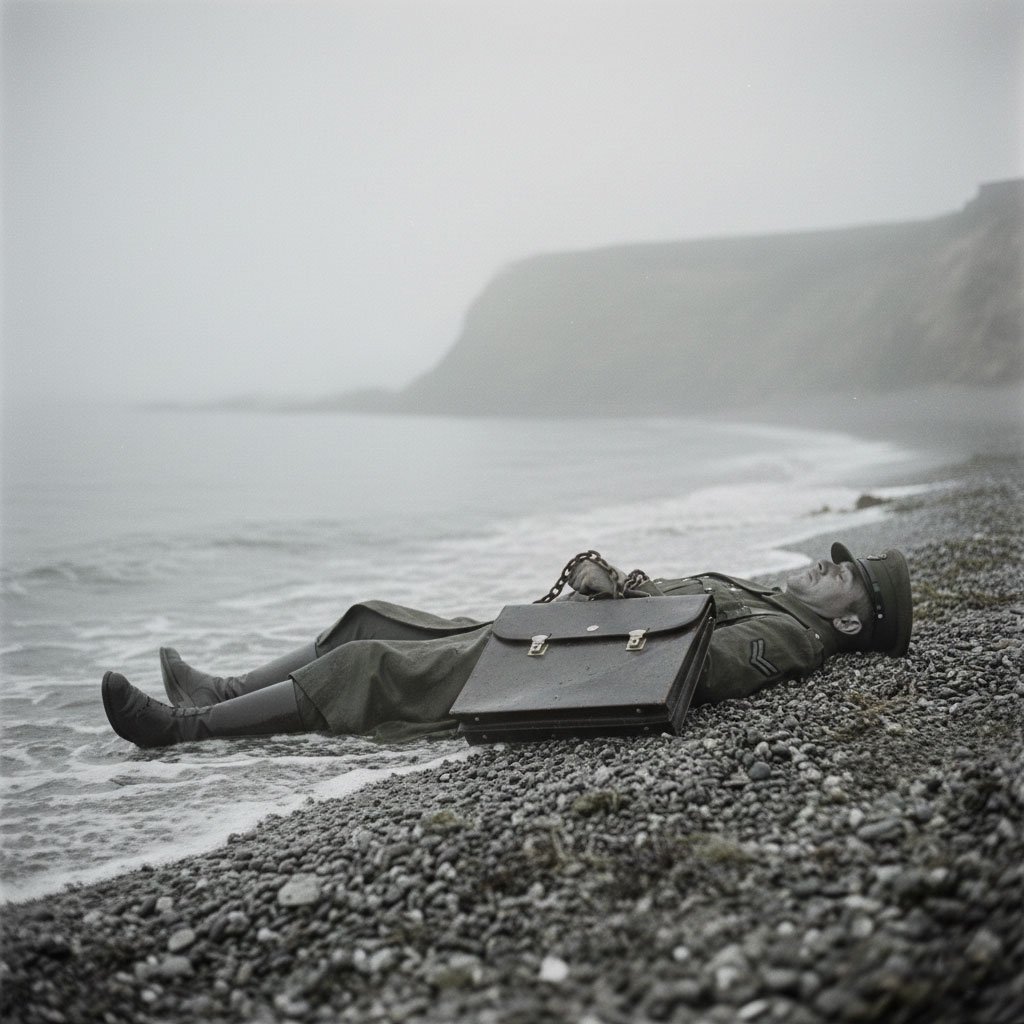
On a cold morning in May 1943, a Spanish fisherman discovered a body washing ashore on the southern coast of Spain — a man in British military uniform, a leather briefcase chained to his wrist. The documents in his pockets identified him as Major William Martin of the Royal Marines, and the briefcase allegedly contained Allied plans for the invasion of Greece and Sardinia. Spanish authorities, officially neutral but quietly sympathetic to Germany, passed copies of the documents to German intelligence, which studied them with painstaking care and reported directly to Hitler that the Allies intended to strike Greece — not Sicily, as had long been expected. The problem was that Major William Martin did not exist. No officer by that name appeared anywhere in British military records. The body belonged to an entirely different man — one who had died weeks earlier in the streets of London.
The real story began two months before that shoreline discovery, inside a classified office in London where Naval Intelligence officer Ewen Montagu was searching for a corpse. He needed the body of a man who had died recently in a way that would allow him to pass as a drowning victim — no obvious signs of autopsy, no disfigurement that would raise suspicion. He found what he needed in the body of a young Welsh drifter named Glyndwr Michael, who had died by suicide after ingesting rat poison following years of homelessness and destitution. His family consented to donating the body to the war effort without ever being told the full details. The corpse was stored in a refrigerated unit for three months while Montagu’s team constructed an entire identity for the fictional Major Martin — love letters from a fabricated fiancée, receipts from London shops, even theatre ticket stubs to suggest a life interrupted.
The Operation That Changed the Course of the War
On the night of April 30, 1943, the frozen body was sealed inside a special metal container packed with dry ice and loaded onto a British submarine bound for the Spanish coast. Before the body was released into the sea, sailors dressed it in a full officer’s uniform and filled its pockets with keys, coins, a photograph of the invented fiancée, two of her handwritten love letters, and a jeweler’s receipt for an engagement ring purchased in London. The leather briefcase contained letters forged with extraordinary precision between high-ranking British commanders, discussing invasion plans for Greece and Sardinia with passing references to Sicily as a decoy. The letters were written in the actual handwriting of real officers, bearing their genuine signatures, and referenced existing military units and complex logistical arrangements — all designed to appear unimpeachably authentic. Even the tides were calculated in advance to ensure the body would drift to shore within hours of entering the water.
German intelligence swallowed the deception entirely. Hitler ordered a full Panzer division transferred from France to Greece, dispatched additional submarines to protect Greek waters, and reinforced Sardinian defenses — all while leaving Sicily significantly under-protected. When the Allies launched their actual invasion of Sicily in July 1943, they encountered far weaker resistance than anticipated, and an operation expected to take weeks concluded in days with substantially lower casualties. Military historians estimate that Operation Mincemeat, as it was named, saved tens of thousands of lives and may have shortened the Second World War by several months. Yet the full details of the operation remained classified for twenty years after the war ended, and when Montagu finally published his account in the 1953 book The Man Who Never Was, numerous details had been redacted and names deliberately obscured.
The Secrets That Were Never Disclosed
Neither the book nor the subsequent film revealed the true identity of the corpse — that remained a government secret for fifty-five years, until 1998, when declassified documents confirmed that the body had belonged to Glyndwr Michael. But even after that disclosure, troubling questions persisted. Witness accounts of Michael’s cause of death contain contradictions, and some researchers have questioned whether his body alone was used in the operation. Dr. Denis Sims, a forensic physician who examined the medical records attached to the operation’s files, noted disturbing inconsistencies in the physical descriptions of the body before and after it was placed in the sea. In a 2003 paper, he observed that certain details simply did not correspond to a corpse that had died of poison three months earlier and been kept frozen — and he stopped short of offering an explanation for what those discrepancies might mean.
What remains even more puzzling is the fate of the original documents recovered from the briefcase. After Spain returned the bag to British authorities, intelligence experts examined the wax seals on the envelopes under a microscope and determined they had been opened and resealed with considerable skill — but they could never confirm whether Germany had obtained genuine copies or only rushed photographs. More unsettling still: three of the seven letters originally placed in the briefcase vanished entirely. Spain returned neither the originals nor copies, and never acknowledged their existence. In 1947, British intelligence submitted a formal inquiry to Spanish authorities asking about the fate of these three missing letters. The Spanish response was brief and final: “No records exist of any additional correspondence.” What those three letters contained — and why Spain concealed them long after the war had ended — has never been explained.
The Man Who Died Twice
In a small cemetery in the Spanish town of Huelva, there is a modest grave bearing a marble headstone engraved with the name “William Martin” and beneath it, in English: “Served his God and his Country.” British officials have visited the grave multiple times over the decades, and in 1998 a small addition was made — a secondary inscription acknowledging the real name, Glyndwr Michael. But the question historians now raise is whether the body buried in that grave is actually Michael’s at all. British author Ben Macintyre, who published a detailed account of the operation in 2010, formally requested that British authorities authorize a DNA analysis of the remains to confirm the identity. His request was denied on the grounds of “respect for the deceased.” When he pressed further and asked why details of an operation conducted seventy years ago remained classified, the Ministry of Defence replied that “certain operational aspects of the mission remain restricted for security reasons.”
More remarkable still, the National Archives in Britain holds a complete file labeled “Operation Mincemeat — Additional Documents,” sealed with the notation “Not to be opened until 2045” — one hundred years after the end of the war. Why would a military deception operation, one that has been publicly acknowledged and written about for decades, require that some of its contents remain locked away for a full century? Some researchers believe the operation was significantly larger than what has ever been disclosed, and that Mincemeat was only one component of a broader series of deceptions involving human remains deployed in similar ways across multiple theaters of the war. Cryptic references in the posthumously published memoirs of several British intelligence officers — phrases like “the five bodies” and “the parallel ghost operations” — appear without elaboration or context, as if the authors knew they could gesture toward something without ever being permitted to name it.
The Secret That Will Never Be Solved
More than eighty years after the operation, historians continue to encounter irreconcilable contradictions in the official record. The photographs of the body taken by Spanish authorities show a man who appears noticeably older than Glyndwr Michael’s documented age, and some Spanish medical reports describe a state of decomposition inconsistent with a person who had drowned only hours before being found. There is also a peculiar testimony from a crew member aboard the British submarine, published in a small British newspaper in 1991, in which the sailor states that the crew deposited “more than one container” into the sea that night. The claim was never investigated. And the largest question of all remains unanswered: why, in 2024, do British authorities continue to refuse a DNA examination of the grave in Spain, and why do sealed files from a concluded wartime operation still carry a classification order that extends to the middle of the twenty-first century?
Perhaps the true story is stranger and more elaborate than anything that has ever been made public. Perhaps Glyndwr Michael — the homeless young man who died alone in London in 1943 — was not the only person who “died twice” in service of the British war effort. Perhaps there are other graves in other European towns, bearing false names above bodies deployed in operations that have never been disclosed. The question that refuses to go away is this: how many “dead spies” did British intelligence manufacture during the Second World War — and how many of them still lie beneath invented names in unmarked corners of the continent, waiting for a secret that may be revealed a century from now, or perhaps never at all?