
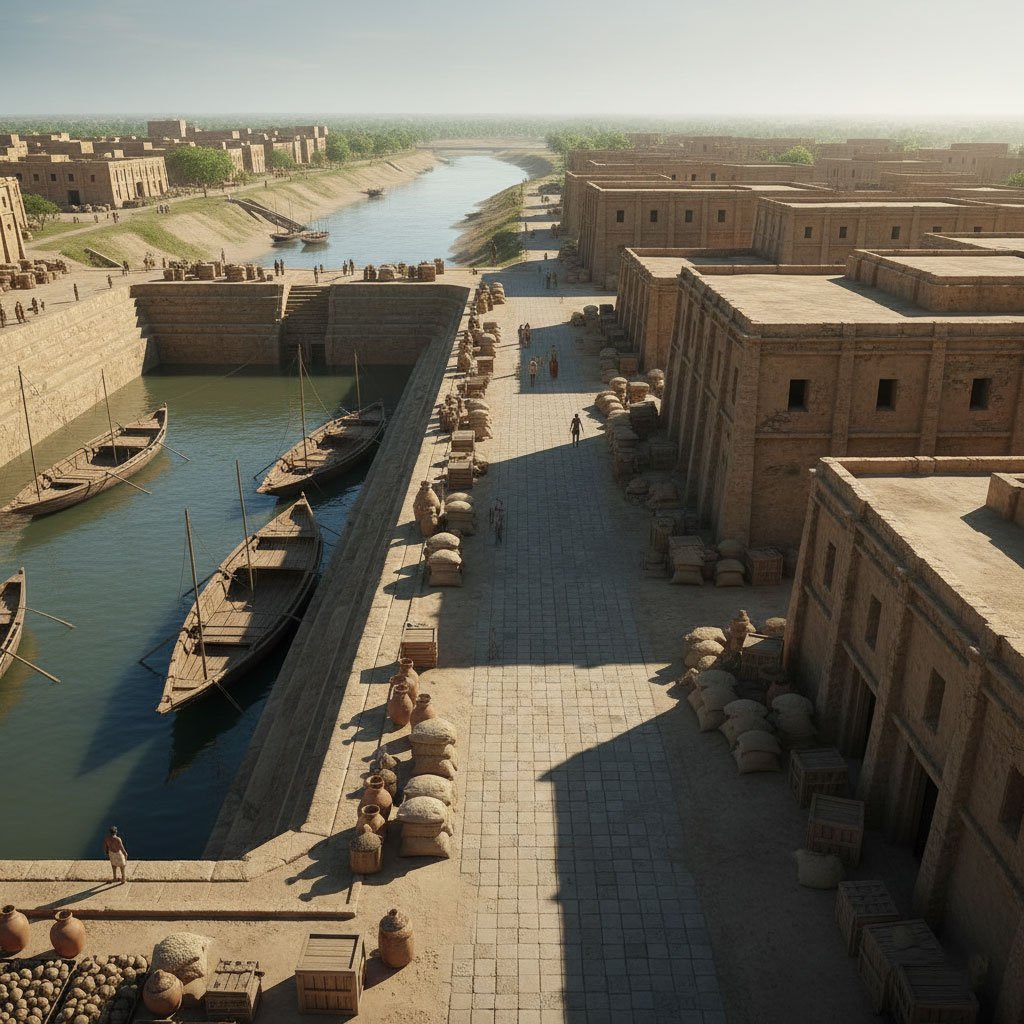
Lothal, one of the most significant cities of the Indus Valley Civilization, was not an ordinary settlement. It was an advanced maritime port — a vital economic artery connecting the ancient world to Mesopotamia and the Arabian Peninsula through trade networks of extraordinary complexity. The city was founded more than 4,500 years ago on the banks of a shifting river, and its urban layout was so precise that it forces a question researchers still cannot fully answer: how did an ancient civilization build a port of this engineering sophistication? Lothal was not merely a trading post. It was a complete urban center combining meticulous city planning, advanced hydraulic engineering, and an economic and social management intelligence that is difficult to accept as real for its era. The city contained refined docking facilities, massive warehouses, and carefully ordered streets — evidence of a population that administered daily life and maritime commerce with skill, even under the challenges imposed by an unpredictable river and a harsh climate.
Urban and Engineering Design
What distinguishes Lothal is not only its advanced port but the internal urban design of the city itself, which reveals an unusual capacity for organizing civic space and managing complex commercial movement. Streets were designed to facilitate the flow of goods, and warehouses were positioned to allow the efficient storage of both heavy and light cargo. The hydraulic systems — including sewage infrastructure and water control mechanisms — were more advanced than those found in many European cities as late as the nineteenth century. The houses in Lothal were nearly uniform in size, with no grand palaces and no visibly impoverished districts, pointing to a society that placed genuine value on balance and social equity and that reflected an unconventional civilizational philosophy regarding the distribution of wealth and resources. The carved seals and tools discovered at the site suggest a community that relied not on rigid centralized authority but on an intricate internal organization built on cooperation and discipline — which makes its later disappearance all the more confounding.
Maritime Commercial Activity
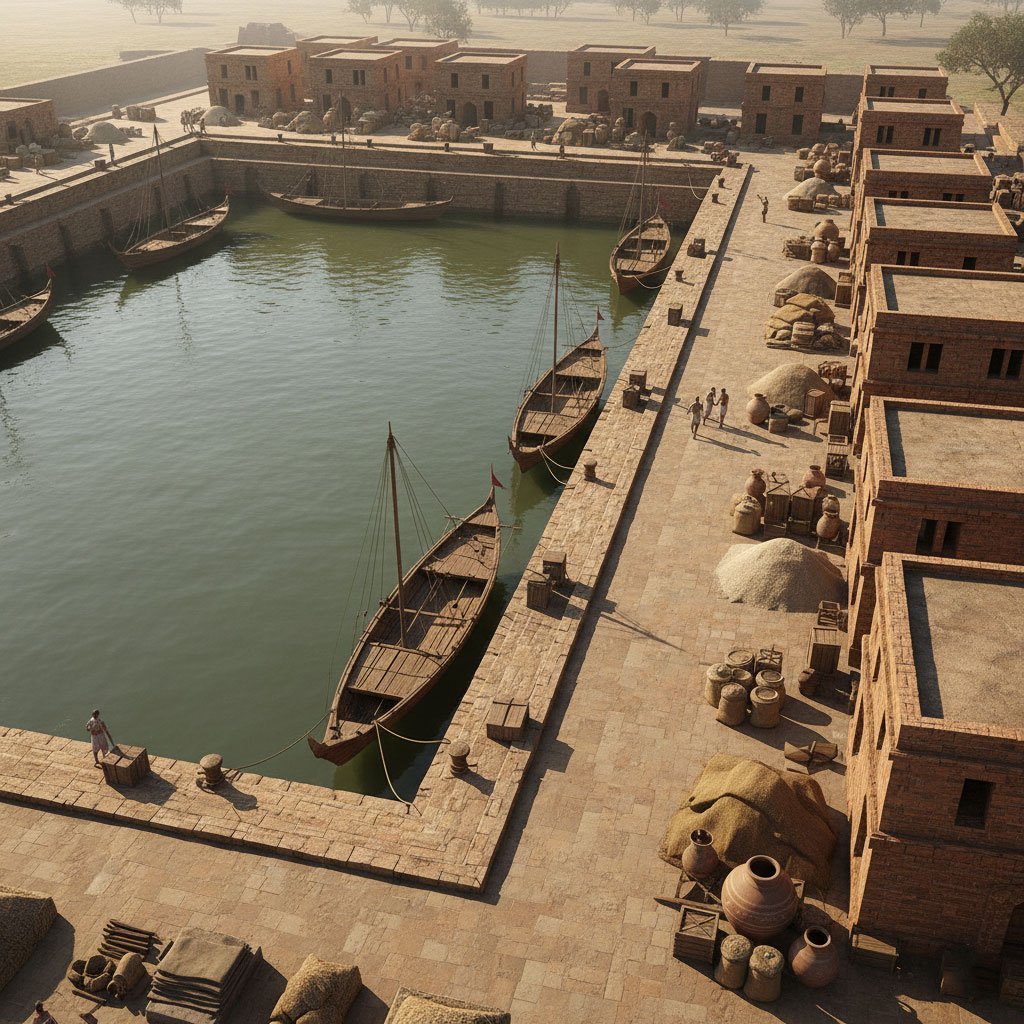
The most remarkable feature of Lothal is its harbor. The docking facilities and basins were engineered to accommodate large commercial vessels, enabling the organized and efficient loading and unloading of cargo. The warehouses running the length of the docks were equipped to store an extensive variety of goods — grain, metals, fishing tools, and textiles — pointing to wide-ranging maritime trade with Mesopotamian civilizations, ancient India, and possibly the Arabian Peninsula. The artifacts recovered, including weights and measurement standards, confirm that the city functioned as a precise center for commercial accounting, operating with a unified system of measurement that reveals the sophistication of Lothal’s economic administration. The maritime tools found at the site also indicate advanced knowledge of ship design, and suggest that Lothal may represent the earliest known example of a port functioning as an integrated maritime trade network in the ancient world.
The Mysterious Disappearance
Around 1900 BCE, the city ceased activity abruptly. Full warehouses, completed docking structures, and clean streets together suggest that the departure was not caused by any obvious natural catastrophe, military attack, or sudden economic collapse. Everything indicates that the population left quietly and systematically, abandoning a fully operational port with no trace of chaos or destruction. Even scientific explanations fail to provide a satisfying answer. Some researchers believe that a change in the river’s course may have rendered the port unusable, while others suggest that earthquakes or slow-moving epidemics gradually weakened the community — but these are all incomplete explanations that cannot account for a withdrawal this organized, and that leave unanswered the fundamental question: why was no replacement port built nearby?
Hypotheses That Offer No Comfort
Beyond the conventional scientific explanations, there are hypotheses that are less reassuring but grounded in genuine observation. Some anthropologists have raised the possibility that the community experienced a rare astronomical event or an unidentified natural phenomenon that affected the population’s collective will, driving them to leave the city gradually and methodically, without resistance or any attempt at rebuilding. Some researchers have also suggested that Lothal may have contained advanced maritime and engineering knowledge that was never transmitted to subsequent generations — perhaps because it was considered dangerous, or because it was never fully understood even by those who practiced it. This would make its disappearance resemble a deliberate collective decision to preserve the secrecy of that knowledge. There is also the hypothesis that the city’s quiet withdrawal reflects a social system so well-balanced that its population was capable of reaching a collective decision without disorder or conflict — which makes Lothal’s end more mysterious than any violent collapse could ever be. The archaeological evidence available today suggests the inhabitants may have moved east and south, leaving behind a complete civilizational network that left no clear imprint on subsequent sites, as though they had deliberately engineered their own total disappearance.
The Question That Will Not Close
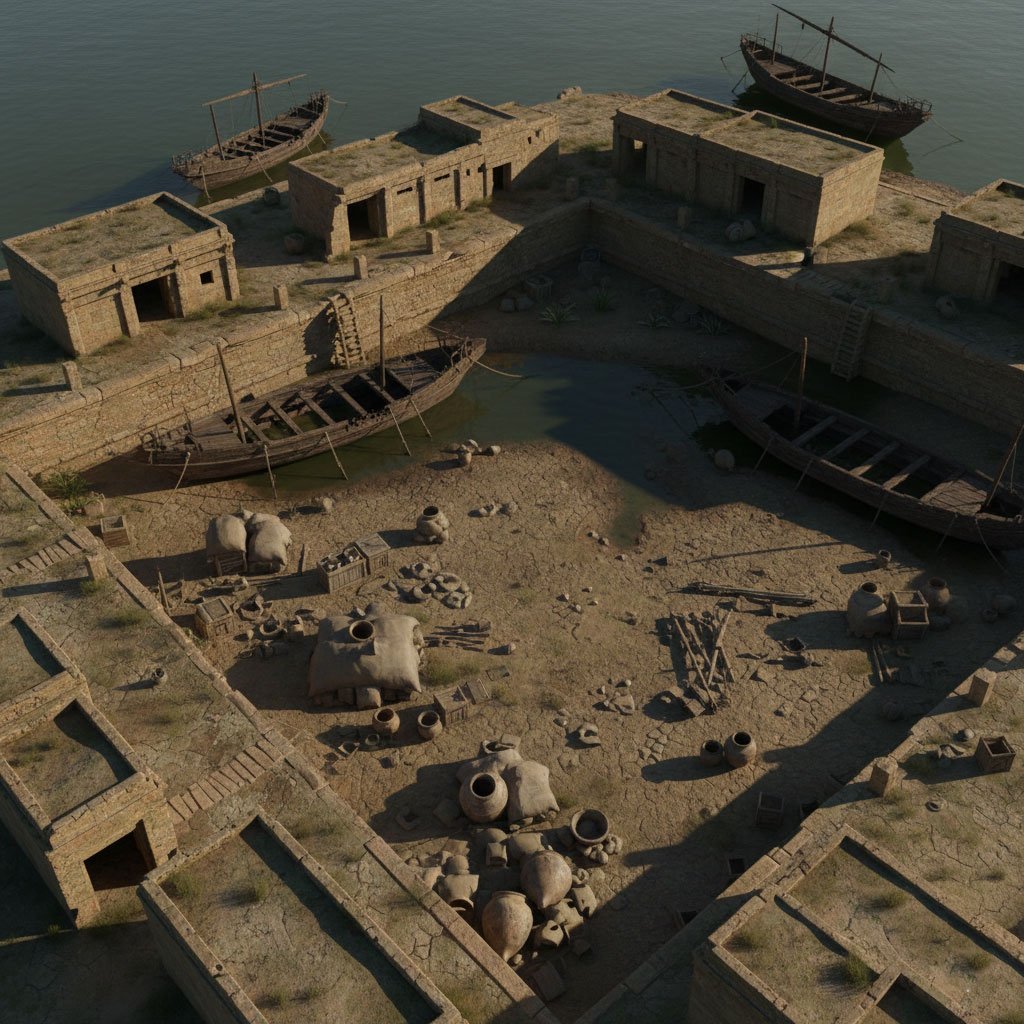
Researchers stand before the ruins of Lothal facing a single disorienting question: how could an economically and socially organized advanced city vanish suddenly, leaving behind a complete port, clean streets, and full warehouses, with no trace of conflict or destruction? The answer remains unknown, making Lothal one of the greatest and most imagination-provoking mysteries of the Indus Valley Civilization — a living example of a civilization’s capacity to disappear in silence, leaving its only lasting mark in the questions that humanity has not yet been able to answer.
What “Mystery Archive” Reads Between the Lines
Technical analysis of the Lothal site reveals operational realities that exceed conventional archaeological interpretation. The harbor’s dockyard was designed to function using a sluice gate system for controlling tidal water levels — the earliest known historical model of hydraulic port management. Scientifically, this implies advanced knowledge of hydrostatic principles and the gravitational effects of celestial bodies on tidal behavior. The eventual failure of this system was not the result of any design flaw but of a tectonic shift that raised the riverbed, leaving the stone dock above the waterline and rendering the port entirely non-functional in operational terms.
The massive warehouses, constructed on elevated mud-brick platforms, point to a logistics system based on standardized unit principles. The internal distribution of warehouse space corresponds precisely to the unified weight systems discovered at the site, confirming that Lothal functioned as a customs clearance and accounting center of considerable precision — not a primitive fishing harbor. The complete absence of ash layers, mass graves, or evidence of looting confirms that the city did not succumb to sudden military or biological destruction. The most scientifically credible explanation is functional death: when the port — the city’s sole operational purpose — ceased to function, the entire infrastructure lost its reason to exist. The organized withdrawal proves that the community operated according to professional evacuation protocols, with warehouses systematically emptied and productive tools relocated, transforming the city from a vital center into an empty stone shell within a remarkably short period of time. Lothal’s rigid adherence to the construction standards of Mohenjo-daro — despite the enormous distance between them — also reveals an administrative system so rigid it lacked local adaptability. When the environment shifted, a system built on total standardization could not adjust; it simply chose extinction over deviation from its own operating parameters.