
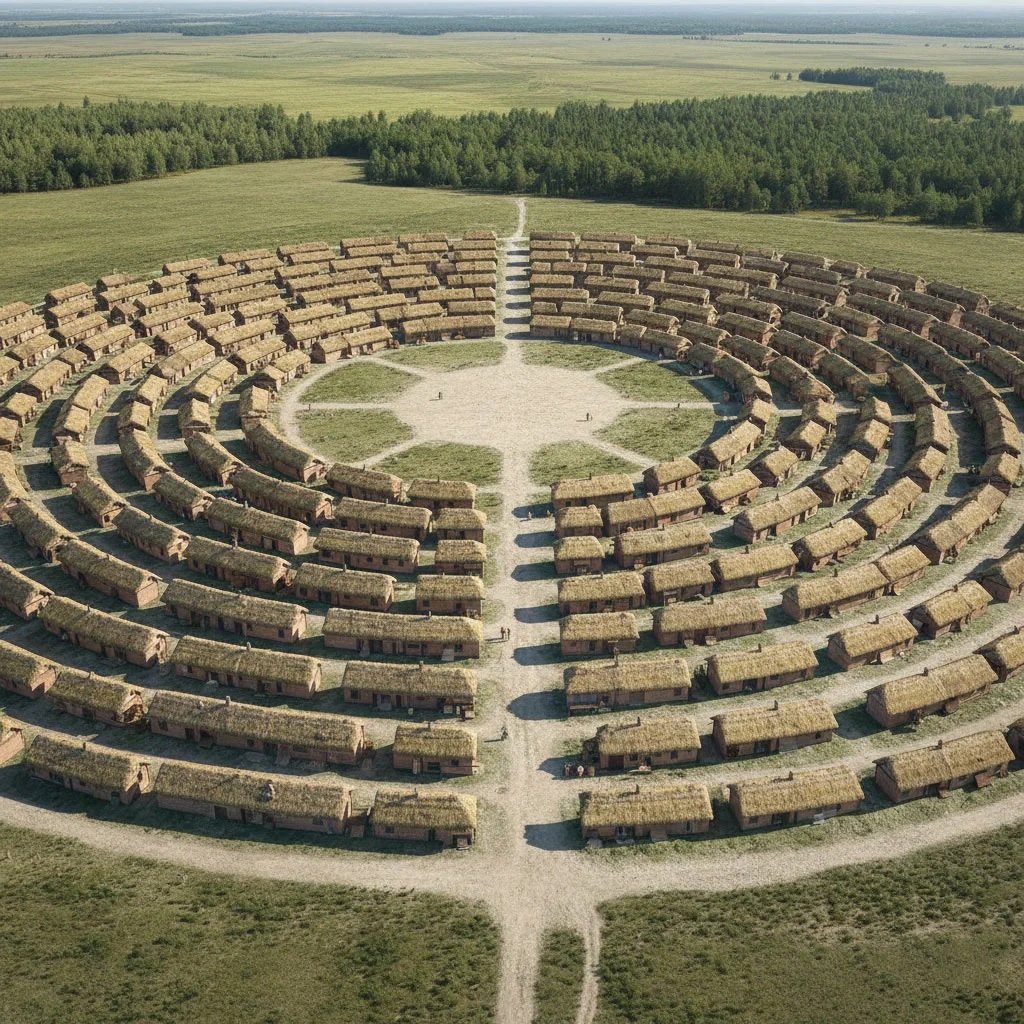
In the heart of Eastern Europe, thousands of years before the emergence of writing, kings, or empires, a civilization arose that refuses to conform to any conventional picture of prehistory. The Cucuteni–Trypillia culture, which flourished between approximately 5400 and 2700 BCE, was not a scattering of primitive agricultural settlements. It was an extensive society that spread across what is now Ukraine, Romania, and Moldova, and succeeded in constructing cities of enormous scale and population at a time when cities were not supposed to exist at all. What disturbs researchers is not merely the civilization’s size but the fact that it appeared almost fully formed — with no clear developmental stages visible in the archaeological record — and then disappeared later in a manner no less strange than its emergence.
Cities Whose Scale Does Not Belong to Their Era
When archaeological excavations began revealing the full extent of Trypillia settlements, it became clear that some exceeded 300 hectares — placing them among the largest population centers anywhere in the ancient world during that period. Some estimates suggest individual cities housed between ten thousand and twenty thousand inhabitants, a figure that is difficult to account for in the complete absence of any known written or administrative systems. These cities were not haphazard. They were organized according to a recurring circular plan in which houses aligned in concentric rings around an open center, indicating a unified urban vision executed with precision across generations. The consistency suggests that society adhered to a fixed civic template from which no deviation was permitted.
Urban Planning Without Any Visible Hierarchy
The houses within Trypillia cities were nearly identical in size and construction — some multi-roomed, some two-storied, with interior ovens and storage areas — reflecting a relatively stable standard of living. What is striking is the complete absence of any architectural distinction that would indicate a ruling elite or a separate wealthy class. There are no palaces, no enclosed districts, no monumental structures asserting dominance over the cityscape. This architectural uniformity raises a deeply uncomfortable question: was this a society organized around genuine equality? Or did authority exist in a form that leaves no material trace — power exercised without visible symbols, without buildings designed to intimidate or impress?
Absent Authority and Total Military Silence
In virtually every known civilization, the marks of power are unmistakable: temples, statues, inscriptions, elaborate burial sites, or defensive fortifications. In Trypillia, nearly all of this is absent. There is no strong evidence for kings, no large religious symbols, no indication of organized armies or sustained warfare. Discovered weapons are few, and defensive structures are almost nonexistent — suggesting a society that was not preoccupied with territorial expansion or organized violence. This dual absence of visible authority and structured conflict makes Trypillia an anomaly in the entire history of human settlement, and deepens the difficulty of explaining how it persisted for centuries without collapsing far earlier than it did.
The Most Unsettling Ritual: The Periodic Burning of Cities
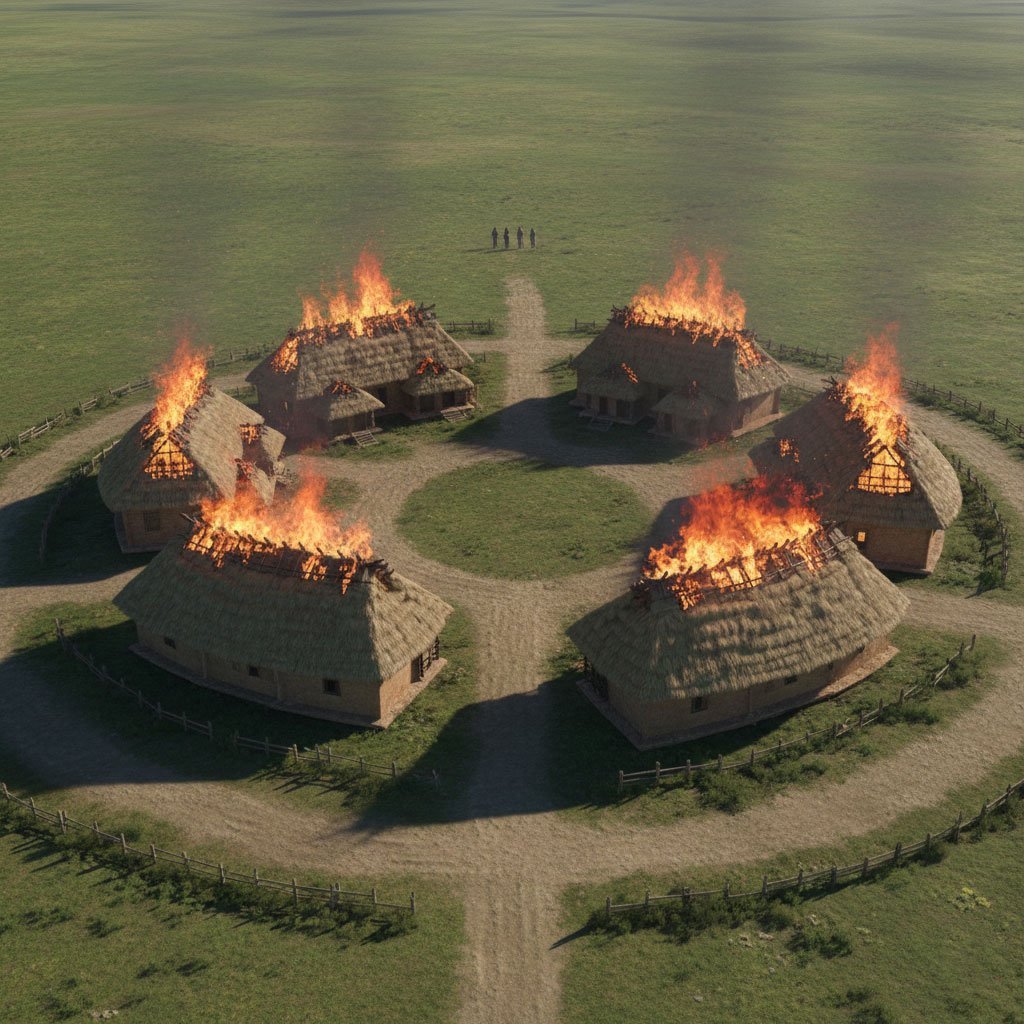
Among the most disturbing features of the Cucuteni–Trypillia civilization is the recurring pattern of deliberately burning entire cities — a burning that archaeological evidence indicates was intentional and organized, not the result of enemy attack or natural disaster. In numerous sites, fully incinerated houses were found alongside remains suggesting that residents had emptied them of essential contents before the fires were set. This behavior repeated itself across generations, leading some researchers to conclude that the burning was a periodic ritual tied to cycles of life or renewal — or perhaps a symbolic means of closing one social chapter before transitioning to the next. What makes this especially troubling is that this ritual, which appeared structured and socially accepted, stopped abruptly in the final phases before the civilization’s ultimate disappearance.
Slow Retreat Without the Signs of Conventional Collapse
Beginning in the late fourth millennium BCE, Trypillia settlements began contracting gradually. The large cities were not suddenly destroyed, and the archaeological record shows no evidence of sweeping invasion or catastrophic famine. Instead, the evidence points to a slow, systematic retreat: settlements shrank, then were permanently abandoned. Stranger still, this retreat was not accompanied by the construction of comparable new cities in nearby regions — as if the urban model itself was abandoned entirely, rather than simply relocated. Whatever Trypillia had been, it was not replaced. It was relinquished.
Dissolution Rather Than Collapse
Unlike civilizations that collapsed violently and left clear ruins of destruction, the people of Trypillia do not appear to have vanished physically. Genetic and cultural evidence points to biological continuity — their descendants persisted and merged into later societies. But there was no civilizational continuity. The circular city pattern did not transfer. The burning rituals did not resurface. The urban organizational system left no inheritors. It is as though this society made a collective decision to abandon its entire civilizational identity rather than defend or evolve it — a withdrawal so complete that it looks, from the outside, less like failure and more like a deliberate act of erasure.
Hypotheses That Trouble Researchers
Conventional explanations point to long-term climate shifts, soil exhaustion from intensive agriculture, or mounting population pressure — but these account for partial decline, not total disappearance. On the margins of academic debate, more disturbing hypotheses have emerged. Was Trypillia’s social system built on a delicate equilibrium too fragile to sustain? Did the absence of centralized authority create an incapacity to make decisive collective choices during moments of crisis? Or did this society hold a fundamentally different conception of continuity and ending — one in which withdrawal was not failure but a rational choice, the natural conclusion of a social cycle that had run its course?
A Civilization With No Desire for Immortality
What distinguishes the Cucuteni–Trypillia civilization above all else is that it made no attempt to memorialize itself. No inscriptions, no statues, no myths carved into stone. All it left behind were enormous cities, burned with care, then surrendered to the earth to be slowly swallowed. Perhaps this civilization was not concerned with being remembered. Perhaps it understood disappearance as the natural terminus of a social cycle rather than a historical tragedy. And this — precisely this — is what makes it so unsettling to contemporary researchers: a civilization that was advanced, organized, and relatively peaceful, which chose to leave no final cry.
What “Mystery Archive” Reads Between the Lines
The operational patterns of this civilization reveal technical realities that go beyond conventional prehistoric interpretation. The rigid repetition of the circular settlement layout — maintained across thousands of square kilometers and more than two thousand years — implies the existence of an unwritten but ironclad social protocol. Scientifically, this geometric consistency reflects a society that actively resisted structural change: the circular design prevented the emergence of independent power centers, making the entire civilization dependent on a horizontal balance so fragile that a disruption at any single point could bring down the whole system, with no central crisis leadership to absorb the shock.
Chemical analysis of soil and clay residue at burned sites has established that interior temperatures reached 1,000 degrees Celsius — heat that no accidental fire produces, but only one prepared through the deliberate packing of highly combustible materials into a structure. Technically, this behavior represents a mechanism of periodic social reset: the systematic destruction of material wealth — the physical dwelling — to prevent the accumulation of class stratification. However efficient this process may have been at maintaining equality, it resulted in the catastrophic depletion of timber resources and energy reserves, likely accelerating the environmental collapse of the surrounding region. The very ritual designed to preserve the civilization’s social balance may have been the slow mechanism of its undoing.
The absence of any evidence of violence or conquest in the final phases points to what might be called voluntary disintegration. From the perspective of sociobiology, when a civilizational model fails to meet the needs of its population — in this case through soil exhaustion — and the society lacks the tools of coercive authority to compel its members to continue working or defending, the population resorts to systematic dissolution: the dismantling of cities and a return to pastoral and nomadic patterns. Trypillia ultimately represents a civilization that possessed extraordinary executive capacity — building cities for twenty thousand people — while lacking entirely the documentary capacity to record what it knew. This operational imbalance meant that its engineering and social knowledge evaporated the moment the physical practice stopped. Knowledge that is never written down perishes with the last generation that carries it.