
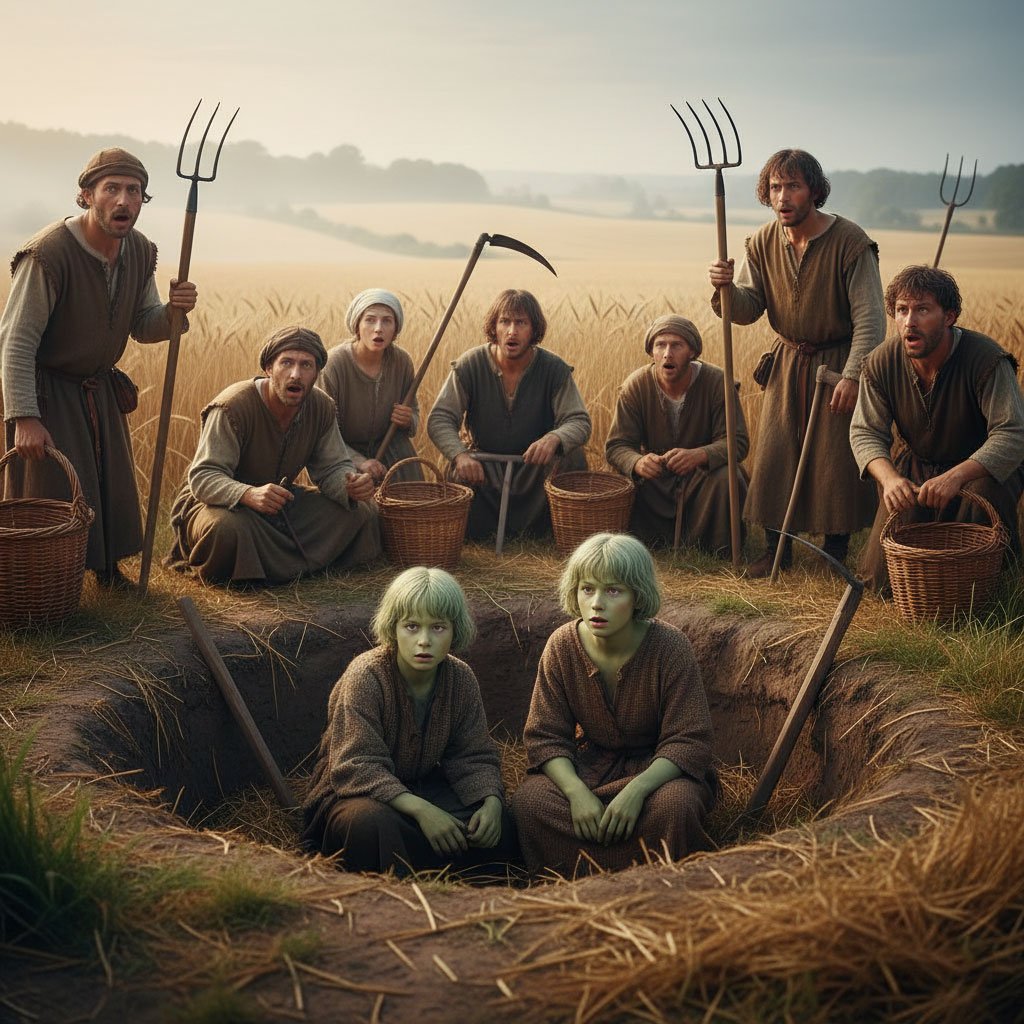
In the summer of 1150 — or perhaps 1135, according to conflicting records — farmers in the small village of Woolpit in Suffolk, England, were harvesting wheat when they heard crying coming from an old pit that had once been used to trap wolves. They approached cautiously and found two small children, a boy and a girl, wearing strange clothing made of a fabric no one had seen before, weeping loudly. But the real shock was not the clothing — it was the color of their skin. It was entirely green, not pale or sickly but green like fresh grass, as though they had been dyed from within. The farmers tried to speak with them but the children spoke a strange language that no one had ever heard, resembling neither English nor French nor Latin nor any known language of the time. They were frightened and disoriented and refused all food offered to them, continuing to cry and point toward the horizon as though searching for something lost.
The children were taken to the home of Sir Richard de Calne, a respected nobleman who owned extensive lands in the area and was considered an educated man. He and his wife attempted to feed them, but they refused everything — bread, meat, fruit. They remained hungry for days until they found raw green beans in the kitchen, at which point they seized them and ate hungrily. For many months they ate nothing but raw green vegetables, and very slowly their skin began to change. The green faded gradually and shifted to ordinary pale color. But the boy grew weaker and sicker and refused to eat more and more, and died after a few months without having spoken a single intelligible word. The girl survived, and slowly began to learn a few English words. After approximately a year she was able to speak in broken phrases.
The Story She Told
When the girl became able to communicate, Sir Richard asked her where they had come from. She told a story that defied belief. She said they had come from a place called the Land of Saint Martin, where there was no sun — only a perpetual dim twilight — and everything was green. She said the people there were all green like herself and her brother, and that they lived in a land beneath the earth or beyond a great river that could not be crossed. She and her brother had been tending sheep when they heard a very loud sound of bells. They followed the sound and entered a cave or dark tunnel. They walked in darkness for a long time until they saw light at the end and emerged — and found themselves in the wolf pit, with the sun blazing and blinding them because they had never seen sunlight before. They tried to return but could not find the cave again, and wept until the farmers discovered them. Sir Richard attempted to locate the cave she described, searching every cave and pit in the Woolpit area, but found nothing. The girl herself could not identify the place with any precision, and as she grew older she began to forget the details — or perhaps chose to forget them. She learned English fully and forgot her original language entirely, a language that not even educated monks who traveled from distant monasteries to hear her could identify. She lived out the rest of her life in Woolpit, eventually married a man from a neighboring village named Richard Barre, and never spoke of her past again.
The Two Historians Who Recorded the Story
The account was not passed down as oral legend — it was formally documented by two of the most respected historians of the medieval period. The first was William of Newburgh, a monk and serious chronicler who wrote about the incident in detail in his Historia rerum Anglicarum, stating that he had heard it from trustworthy eyewitnesses. The second was Ralph of Coggeshall, an abbot and royal historian who recorded almost the same account in his manuscripts. What is striking is that both men wrote independently, from different sources, yet the essential details were identical: the green skin, the strange language, the beans, the death of the boy, the story of the land with no sun. This means the incident was widely known and spoken of at the time and was not the invention of a single imagination. Both historians were notably careful in their credulity. William of Newburgh wrote: “I long hesitated to mention this matter, for it seemed beyond credibility, but I was at last overcome by the weight of testimony from so many men of such standing.” Ralph of Coggeshall wrote something similar: “I heard this from men of truth who do not lie, but I cannot explain it.” This kind of scholarly restraint indicates that neither man was attempting to invent fiction — they were documenting something they had heard from multiple sources and did not know what to do with.
The Explanations That Fall Short
Historians have proposed various explanations across centuries. The most common is that the children were Flemish or foreign orphans who became lost in the forest and suffered from hypochromic anemia — iron deficiency severe enough to give the skin a greenish pallor. But this cannot account for the language that no educated person in medieval England could identify, or the detailed account of a land without sunlight. Others have proposed that they belonged to some isolated indigenous British community using plant-based body pigment, but no such community is documented anywhere in twelfth-century England, and even if one existed it cannot explain why their language was unrecognizable to anyone who heard it. The most ambitious modern interpretation proposes that the story reflects a genuine crossing between dimensions or worlds — a brief opening in reality that allowed the children to pass through and then closed. This sounds like science fiction, but it is the only framework that accommodates every detail simultaneously. Some writers have connected the story to the British fairy tradition, which speaks of a hidden fairy world existing beneath the hills or beyond the mist, where time moves slowly and the sun does not shine — a description that matches what the girl reported with uncomfortable precision.
The Secret That Died with the Girl
The green girl lived to an advanced age and bore children of entirely ordinary appearance and complexion. But according to some accounts she remained quietly sad throughout her life, as though longing for something lost. Neighbors described her sitting sometimes at dusk, looking toward the horizon with sorrowful eyes as though remembering another place. She died sometime after 1189 and was buried in the churchyard at Woolpit, though no one knows exactly where her grave is today. With her died the real secret of what had happened. Was she truly from another world? Was her memory genuine, or was she a lost child who had invented a story to explain something she herself did not understand? The village of Woolpit still exists in Suffolk, and there is still a sign at its entrance telling the story of the green children. Visitors sometimes come looking for the wolf pit or the mysterious cave. No one finds anything. Perhaps there was once a gap in reality that opened briefly and then closed forever. Perhaps there is another world somewhere very close that we simply cannot see. Or perhaps the story is something else entirely that we will never understand. The only person who knew the truth has been in the ground for more than eight hundred years, and she is not telling.