
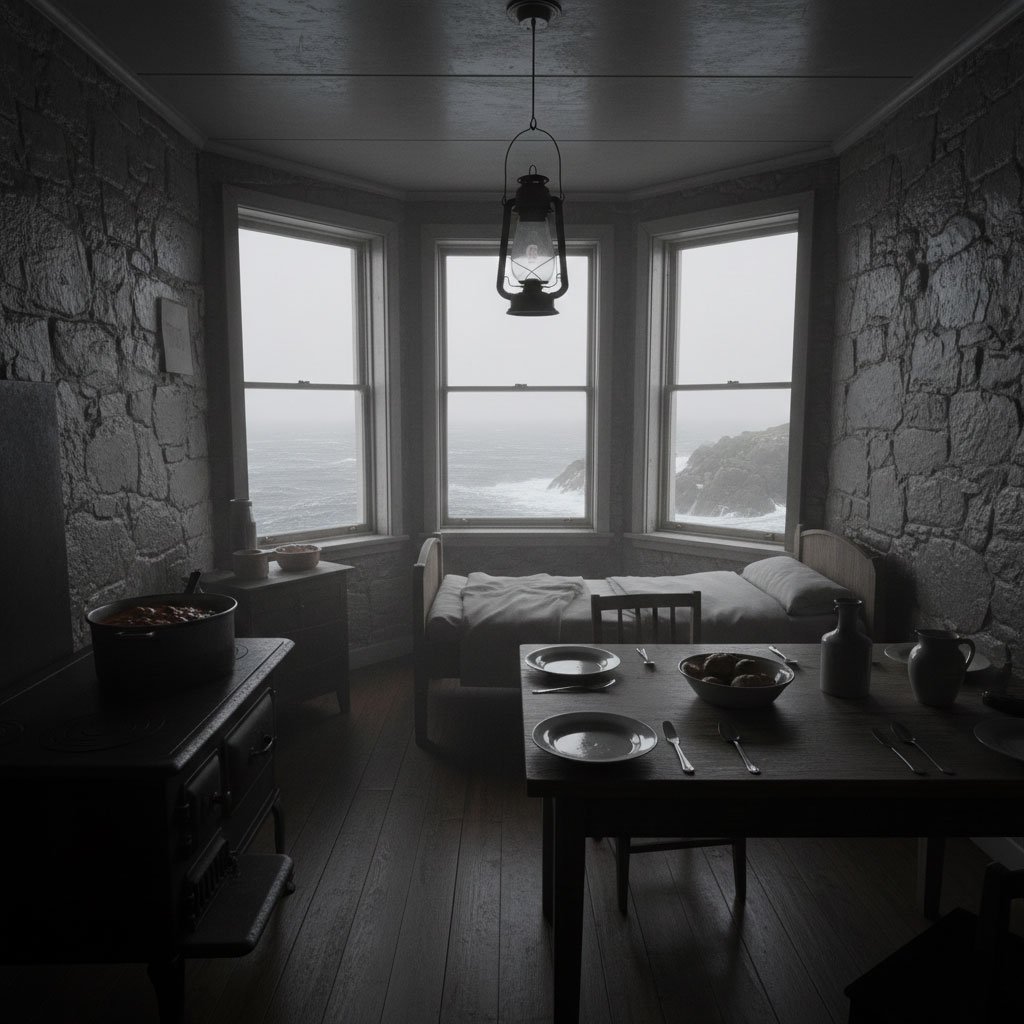
On the fifteenth of December 1900, the supply vessel Hesperus arrived at the remote Flannan Isles off the west coast of Scotland to deliver food and fuel to the three lighthouse keepers who lived there in complete isolation. The islands were bare rocks in the middle of the Atlantic, inhabited by nothing but birds and seals. When the ship anchored and Captain James Harvey sounded the whistle, no one responded. He waited and sounded again, then a third time, but the silence was absolute. He sent his assistant Joseph Moore to shore. Moore climbed the long stone stairway leading to the lighthouse, his heart beating hard because something was deeply wrong. The main door was closed but unlocked, and when he pushed it open and stepped inside he found the lighthouse completely empty. The clocks had stopped, the lamp was dark, and the three keepers had vanished as though they had dissolved into the air.
Moore entered the living quarters and found a table set for a meal — chairs arranged, plates clean, as though someone had been about to eat and then stopped abruptly. The bed in one room was unmade, a blanket thrown on the floor. In the kitchen a pot sat on the stove containing the hardened remains of a meat stew. Everything was ordinary and terrifying at the same time, because the three men were not there. Their coats were hanging on the pegs and their boots were beside the door. The official lighthouse log was open on the table, and the last entry was dated the fifteenth of December at nine in the morning: “Storm ended. Sea calm. God is over all.” But according to official weather records for the area, there had been no storm that day.
The Evidence That Contradicts Itself
Moore hurried back to the ship and told Captain Harvey what he had found. They returned together with other sailors and searched every inch of the lighthouse for clues. They found that two of the three heavy-weather coats assigned for outdoor use in rough conditions were missing, but the third was still hanging in its place. This meant one of the keepers had gone out into the bitter December cold without a coat — something no rational person would do on a remote island in the middle of the ocean in winter. They descended to the stone landing pier where the keepers received supply boats and found a large storage chest overturned and some equipment scattered, as though something violent had occurred there. But the chest was extremely heavy, bolted to the ground with four large iron bolts specifically to prevent it moving in storms. What could have been powerful enough to overturn it?
The official inquiry conducted by the Northern Lighthouse Board concluded that a severe storm on the twelfth of December had likely swept the three keepers into the sea while they were attempting to secure the equipment. But this explanation was full of alarming inconsistencies. If they had died on the twelfth, who wrote the log entry on the fifteenth stating the storm had ended? Why would all three keepers go to the pier simultaneously, leaving the lighthouse unattended — a direct violation of their strict standing orders, which required at least one keeper to remain inside the lighthouse at all times under any circumstances? And if a massive wave had struck them, why was there no sign of water damage inside the lighthouse, which stood 150 feet above sea level?
The Testimony That Was Not Written in the Report
Two weeks before the disappearance, a passing cargo vessel near the Flannan Isles reported something unusual. The lighthouse was lit, but the light was flashing irregularly, as though someone was attempting to send a distress signal. When the captain tried to approach, the storm prevented him, and by morning the light appeared normal again. He filed a report, but it disappeared from the official record and was never mentioned in the inquiry. One of the sailors aboard the supply vessel Hesperus wrote in personal diaries published fifty years after his death that he had found in one of the lighthouse rooms a religious book open to a passage about the end of the world, with a pen and a piece of paper beside it bearing the words “God is our only refuge” in a trembling hand. This was never mentioned in any official report. Joseph Moore himself, the man who discovered the empty lighthouse, spent the rest of his life pursued by nightmares and refused to return to work at any isolated lighthouse. In a letter to a friend in 1905 he wrote that he felt something strange in that lighthouse, as though the walls themselves were afraid. “I do not know what happened to those men,” he wrote, “but I know it was not an ordinary storm.” Even Captain Harvey, a practical and unsentimental man, included in his personal report a sentence that was removed from the final government version: “There are things in the sea that we do not understand and should not attempt to understand.”
The Theories That Never End
For more than a century people have attempted to explain what happened at the Flannan lighthouse. A freak rogue wave sweeping the island cannot account for why all three men left the lighthouse unattended or why one went out without a coat. A murder or collective suicide left no evidence of violence or blood, and no conceivable motive. Escape by boat was impossible — there was no boat on the island, and there is nowhere to escape to from a lighthouse in the middle of the ocean. In 1947, private diaries kept by one of the three keepers, Thomas Marshall, were discovered preserved at his family home. The last written page was dated the tenth of December. In it he described a strange sound he had been hearing at night coming from the sea — “like screaming or crying, but not human.” He wrote that his two fellow keepers had been behaving with unusual nervousness and fear, and that one had refused to sleep and spent his nights watching the sea from the window. These diaries were never officially published, never added to the inquiry record, and when a journalist attempted to access them in the 1960s he was told they had been lost. Whether they were genuinely lost or deliberately withheld is a question the record cannot answer.
The Silence That Will Not Break
The Flannan lighthouse continued to operate after the incident with new keepers, but many of them requested transfers after short postings. Some spoke of strange sounds and the feeling of being watched. A keeper wrote in an official report in 1912 that he had seen three shadows standing at the pier at dusk, but when he descended found no one there. He was dismissed from the service and accused of drunkenness, but swore until his death that he had been completely sober. The lighthouse was permanently closed to human habitation in 1971 and converted to automatic operation. No one lives there now, and the islands have returned to their complete isolation.
Three ordinary men disappeared from a confined place with no exit except the sea. They left behind a table set for a meal, a tidy lighthouse, and a log speaking of a storm that did not happen. Their bodies were never found. No trace of them was ever located anywhere in the world. The official inquiry closed the file with an explanation that satisfies no one, and the most disturbing testimonies were removed or lost. What happened on those rocks on that December night? What did those men see that drove all three of them out into the freezing cold at once? And where did they go? No one knows. No one ever will. The sea does not give up its secrets.