
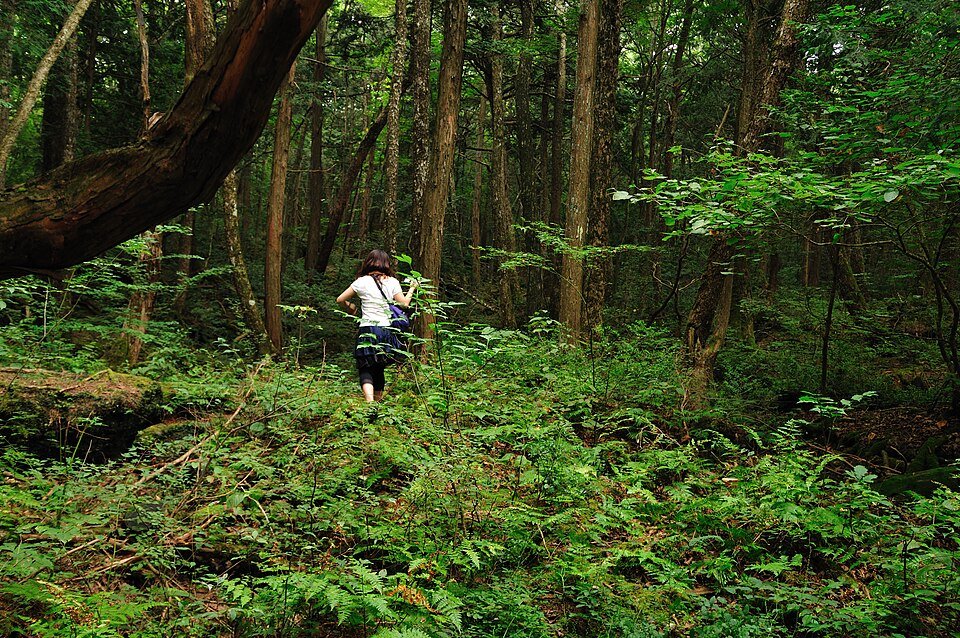
On the morning of August 14, 1987, a Japanese man named Kenji Hatano entered Aokigahara Forest at the foot of Mount Fuji carrying a small backpack and a professional camera. He was a well-known nature photographer based in Tokyo, and he had come to capture images of the forest’s dense canopy in the early morning light. He told his wife he would be back before noon — they had a lunch arrangement with friends. He never returned. Three days later, police found his car in the parking area at the forest entrance and launched the largest search operation in the region’s history. Three hundred volunteers with police dogs and helicopters combed the forest for two weeks and found nothing: no body, no clothing, not even the camera. What struck the search team’s handlers most deeply was the behavior of the trained dogs. They lost the trail entirely after two hundred meters inside the forest, then began barking hysterically and refused to continue. One trainer wrote in his official report that the dogs were “behaving as though terrified of something invisible,” and that in twenty years of work he had never seen them react this way. Kenji Hatano became one of hundreds of people who have entered Aokigahara and never come out.
Aokigahara lies approximately one hundred kilometers west of Tokyo, covering thirty square kilometers at the northwestern base of Mount Fuji. It grew over lava fields from an 864 CE eruption, and its trees are twisted at unusual angles, their roots tangled across black volcanic rock in ways that make walking through it genuinely difficult. The Japanese call it Jukai — “sea of trees” — because the canopy is dense enough that sunlight barely penetrates even at midday. Its other name, the one that appears in darker conversations, is the Sea of Trees’ more brutal translation: the Suicide Forest. Between fifty and one hundred people enter it every year and do not return. The Japanese government publishes official figures classifying most of them as suicides, but the families of the missing tell a different story. Many of those who disappeared — like Hatano — were content people with no apparent motive for self-harm, who entered the forest for ordinary purposes: hiking, photography, mushroom gathering. Then they vanished without explanation.
The Strange Phenomena That Will Not Stop
Everyone who enters the forest notices immediately that something is fundamentally wrong. Compasses stop functioning entirely due to the high concentration of magnetic iron in the volcanic rock, making navigation inside the forest nearly impossible. Mobile phones and GPS devices lose their signal within a hundred meters of entry, despite a powerful cellular tower standing only five kilometers away. But stranger than the technical failures is the silence. There are no birdsongs inside the forest, no insects, no sound of leaves moving — even when the wind outside is strong. Many visitors have described this silence as “unnatural,” “suffocating,” and producing “the feeling that the forest is watching you.” Biologist Takeshi Murakami of Tokyo University studied the forest in 2003 and found that the density of birds and animals within it was 80 percent lower than in adjacent forests under identical environmental conditions. His published report stated that “an unknown factor causes wildlife to avoid this area,” but he was unable to identify what that factor was. Annual police searches conducted since 1970 recover dozens of bodies each time — but not all of them show patterns consistent with suicide. In 2012, searchers found a man in full hiking gear, carrying a map and food and water for three days, lying on the ground with his arms stretched forward as though reaching toward something or fleeing from something. He was thirty years old with no prior health conditions. The medical examiner recorded cause of death as “sudden cardiac failure.” In 2015, five bodies were found within an area of fifty square meters, all in similar unusual postures, as though they had been running from the same thing. A leaked internal police report noted that “the distribution and positioning of the remains is inconsistent with known suicide patterns” and referenced “the possibility of an unidentified external factor” — but the investigation was formally closed and every case was classified as suicide.
The Testimonies They Refuse to Believe
There are rare cases of people who entered the forest and emerged alive, but their accounts were too strange for most people to accept. In 1998, a Japanese woman named Yoko Takahashi walked out of the forest after three days lost inside it. She was in a hysterical state and suffered a complete psychological breakdown, spending six months in a psychiatric facility. For years after her release she refused to discuss the experience, but in 2008 she agreed to speak with an investigative journalist. She said she had seen “human-shaped forms moving between the trees that were not real people.” She heard “voices whispering her name from every direction simultaneously.” And time inside the forest “moved incorrectly” — the three days felt subjectively like two weeks. She also described walking in what she was certain was a straight line on the second day and repeatedly returning to the same tree. When the journalist consulted psychologists, they suggested she had likely experienced hallucinations from hunger and fear. Takahashi maintained that everything she described was real, and stated she would not approach the forest again for any amount of money. In 2006, three European tourists entered despite warning signs, wanting to film the famous location. One was carrying a video camera and recording continuously. After four hours, two of them emerged in severe distress. The third never came out. The recording the survivors carried showed something unusual: in the final ten minutes of footage, screaming can be heard from a distance, then the camera shakes violently, and the missing man’s face briefly fills the frame as he shouts “something is following us” before the recording cuts out abruptly. Police searched for a week and found nothing. The two survivors told investigators they had heard their friend screaming behind them and then the screaming stopped suddenly, and when they turned back they could not find him despite being only thirty meters away. The footage was confiscated by police and never officially released. A leaked version appeared online in 2011 and was deleted within days, and anyone who attempted to repost it received legal warnings from Japanese authorities.
The Study That Stopped Abruptly
In 1993, Kyoto University assembled a team of eight researchers — specialists in geology, botany, zoology, and physics — to conduct a comprehensive scientific study of the forest and investigate why so many disappearances had occurred there. They entered with sophisticated instruments, measuring equipment, cameras, and radio devices, and planned to remain for a full week. After two days, all eight left in a state of severe disturbance and refused to continue. The team leader, Professor Hiroshi Nakamura, immediately submitted his resignation from the university and never spoke publicly about what had occurred. One team member, speaking ten years later on condition of anonymity, said they had recorded “highly anomalous readings in the magnetic field” and that their instruments had been “producing physically impossible values.” Every member of the team developed severe headaches, nausea, and dizziness after six hours inside the forest. The source also said the cameras had recorded “things that could not be explained” but refused to go into further detail. All data and recordings were classified by the university and officially destroyed one year later. No research paper was ever published from the study.
The Japanese government has installed warning signs at every forest entrance — “Your life is a precious gift from your parents,” “Think of your family,” “Call the helpline” — all of which presuppose that anyone entering intends self-harm. There are no signs warning about unexplained disappearances or anomalous phenomena. In 2018 the government announced a plan to install surveillance cameras at the forest entrances; the project was cancelled two months later without official explanation. An anonymous government source told a local newspaper the cancellation was for “technical reasons” and declined to specify what those were. In 2020, Japanese authorities banned all journalists and photographers from entering the forest without prior official permission, and every permission request submitted since has been refused without explanation. The pattern reads as a deliberate policy of keeping what happens inside that forest away from the eyes of the outside world.
The Secret Buried Under the Trees
Independent researchers have proposed that the answer lies in the volcanic rock beneath the forest — specifically in the unusually high concentrations of magnetic minerals that could affect the human brain in ways not yet understood, causing hallucinations, spatial disorientation, and confusion severe enough to prevent people from finding their way out. But this explanation cannot account for bodies found in postures suggesting flight from something, or for a scientific research team abandoning a study after two days and destroying all its data, or for why the government suppresses information and bars access. Others invoke the forest’s history as a site where, during medieval famines, elderly people were left to die — suggesting that something accumulated there in the intervening centuries. Neither explanation addresses the full scope of what has been documented.
Perhaps there is a rare natural phenomenon occurring in Aokigahara that existing science has no framework to explain. Perhaps there is something else — something older and stranger — that lives under those twisted trees and does not want to be found. Or perhaps the Japanese government knows something it has decided the world should not be told, and the suppressed studies, confiscated footage, and denied press permits are the visible edge of that decision. The question that remains is the simplest and the most unanswerable: where do all these people go? What did the Kyoto research team record before their data was destroyed? Why do trained police dogs stop at two hundred meters and refuse to continue? No one who could answer is speaking. And the forest, which has been keeping its own record for a very long time, is not telling either.