
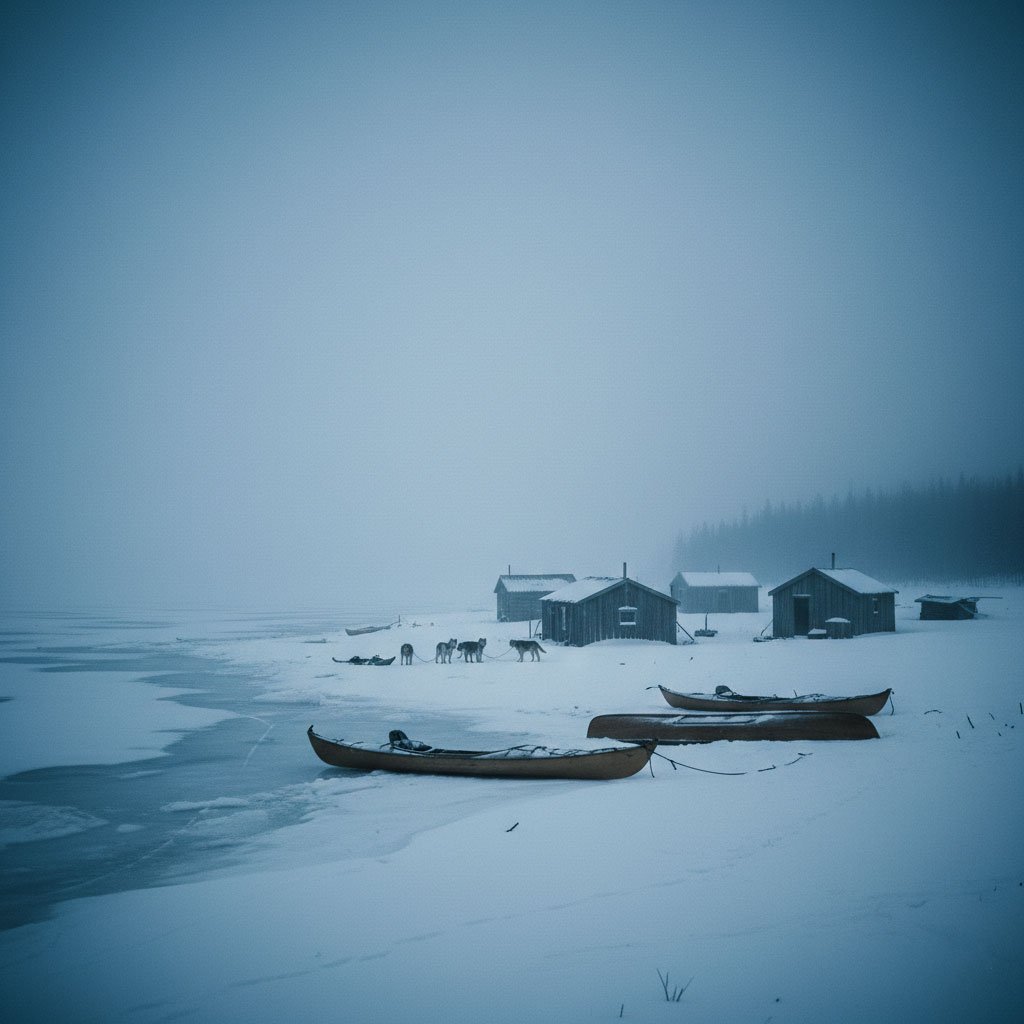
On the morning of November 28, 1930, an Inuit trapper named Joe Labelle set out on his regular route toward Lake Anjikuni in northern Canada. He knew the small village on the lake’s shore well — he had visited it dozens of times over the years and regularly traded with its thirty inhabitants. But this time something was immediately wrong. As he approached the village he heard none of the usual sounds, saw no smoke rising from the huts, detected no movement of any kind. He stopped at the first dwelling, pushed open the hide door, and stepped inside to find a meal half-eaten on a wooden table, a rifle hanging on the wall, and clothing folded with care. He moved to the second hut, then the third, then the tenth. All of them were the same — full of the evidence of life, completely empty of people. It was as though the thirty inhabitants had stood up in the middle of their meals and daily activities and simply ceased to exist.
Labelle traveled as fast as he could to the nearest police post, hundreds of kilometers away, and reported what he had found. Canadian investigators arrived days later and found the scene exactly as he had described it — but with details stranger still. The sled dogs were tied beside the huts, dead from starvation. The Inuit treat their dogs as members of the family and do not abandon them under any circumstances. The kayaks were lined up on the shore — the only means of travel in that remote region. And the village’s burial ground had been opened: the bodies of the previously buried dead were gone. Thirty people had vanished without taking a single possession, and without leaving a single footprint in the snow that blanketed the entire area.
The Investigation That Found Nothing
The Canadian authorities launched the largest search operation the northern territory had seen, deploying Royal Canadian Mounted Police alongside local hunters, volunteers from neighboring tribes, and the most skilled indigenous trackers available — people capable of reading the faintest details in snow. They used trained dogs and small aircraft and covered thousands of square kilometers around Lake Anjikuni. They found nothing at all: no footprints, no vehicle marks, no evidence that a large group of people had passed through. This was logically impossible. Thirty people cannot move across snow-covered terrain without leaving a single trace; every step leaves a mark that remains visible for weeks in those conditions. The investigators also found no bodies anywhere in the surrounding area, despite temperatures reaching forty degrees below zero — temperatures in which anyone leaving shelter without heavy clothing would die within hours.
Canadian newspapers covered the story extensively, calling it the “Anjikuni Village Disappearance.” Every proposed explanation collapsed against the physical evidence. A raid by a hostile tribe: no signs of conflict, nothing valuable stolen. A mass-death epidemic: why were the old graves opened and the previous dead also gone? An animal attack: no blood, no signs of struggle anywhere. The Royal Canadian Mounted Police issued an official statement in 1931 declaring the investigation had reached a dead end and closing the file. But eighty-nine pages of the original investigation report were redacted before publication and remain sealed to this day in the Canadian National Archives under a classification still listed as active — more than ninety years after the events they describe.
Other Stories from the Same Region
Anjikuni was not an isolated incident. Five years earlier, in 1925, a family of seven had vanished without trace from a nearby area. In 1936, fourteen hunters disappeared from a camp two hundred kilometers from the lake; the camp was found intact with all equipment and food in place and no human beings anywhere. Indigenous peoples of the region describe cases stretching back centuries — groups that disappeared in that land across generations. An elder of the Cree nation, speaking in a 1947 interview, said his ancestors had avoided the area around Lake Anjikuni for as long as anyone could remember and called it “the place where the earth takes souls,” believing it to be the location of an invisible force that pulled human beings into another world. Western researchers dismissed these accounts as local folklore. In the 1980s, a team of Canadian researchers attempted to formally reopen the investigation and requested official access to the redacted pages of the original report. The government refused without explanation. One of the researchers, Dr. Frank Grieves, wrote in personal memoirs published after his death in 2003 that he had obtained information from a source inside the National Archives indicating that the redacted pages contained eyewitness accounts of “strange lights in the sky” on the night the village disappeared. The source refused to be identified, and the information could not be independently verified. When Grieves and his team attempted to visit the village site in 1984, they found the Canadian authorities had declared the area a restricted military zone with no stated reason, and all access was denied.
Theories That Explain Nothing
Every explanation that has been proposed for what happened in November 1930 breaks down at the same point: thirty people cannot vanish from a snow-covered landscape without leaving a single mark. A natural disaster such as an avalanche or blizzard does not explain the absence of bodies, the disappearance of the previously buried dead, or the complete lack of physical disturbance in the surrounding terrain. A fleeing population does not abandon its only means of transportation, leave its dogs tied to die, and walk out into minus-forty temperatures without food or clothing. An attack leaves signs — blood, disorder, missing valuables. None of these were present. Some researchers have proposed classified military experimentation by the Canadian or American government, though no motive can be established for targeting an isolated community of thirty people who posed no threat to anyone. Others have cited anomalous magnetic phenomena in the region, for which there is no scientific evidence. The only confirmed fact is that thirty human beings disappeared from their village in a single night and have not been accounted for in the ninety-three years since.
The Secret Buried in the Archive
The official file for the Anjikuni disappearance exists in the Canadian National Archives in Ottawa under classification number RG-18-A-1. It consists of two hundred and thirty-seven pages. Eighty-nine of them are redacted and sealed under a security classification that remains active. Every attempt to access those pages has been refused. When an investigative journalist submitted a formal Freedom of Information request in 2015, the response stated that releasing the information “could harm national security” — without explaining how details about the disappearance of a small village in 1930 could constitute a security threat to a nation in the twenty-first century. That unexplained reasoning may be the most telling detail in the entire file. Governments do not suppress ninety-year-old information about ordinary tragedies. They suppress information about things they are still not prepared to explain — or things that, if explained, would require them to account for decisions they would rather leave buried in the snow.
Where did thirty people go in one night, leaving their food on the table and their dogs tied to the posts? What was written in those eighty-nine pages that cannot be read? What did the eyewitnesses describe seeing in the sky that night over Lake Anjikuni? No one who knows is speaking. And the Canadian winter, which covers everything eventually and keeps what it covers for a very long time, has not offered any answers of its own.