
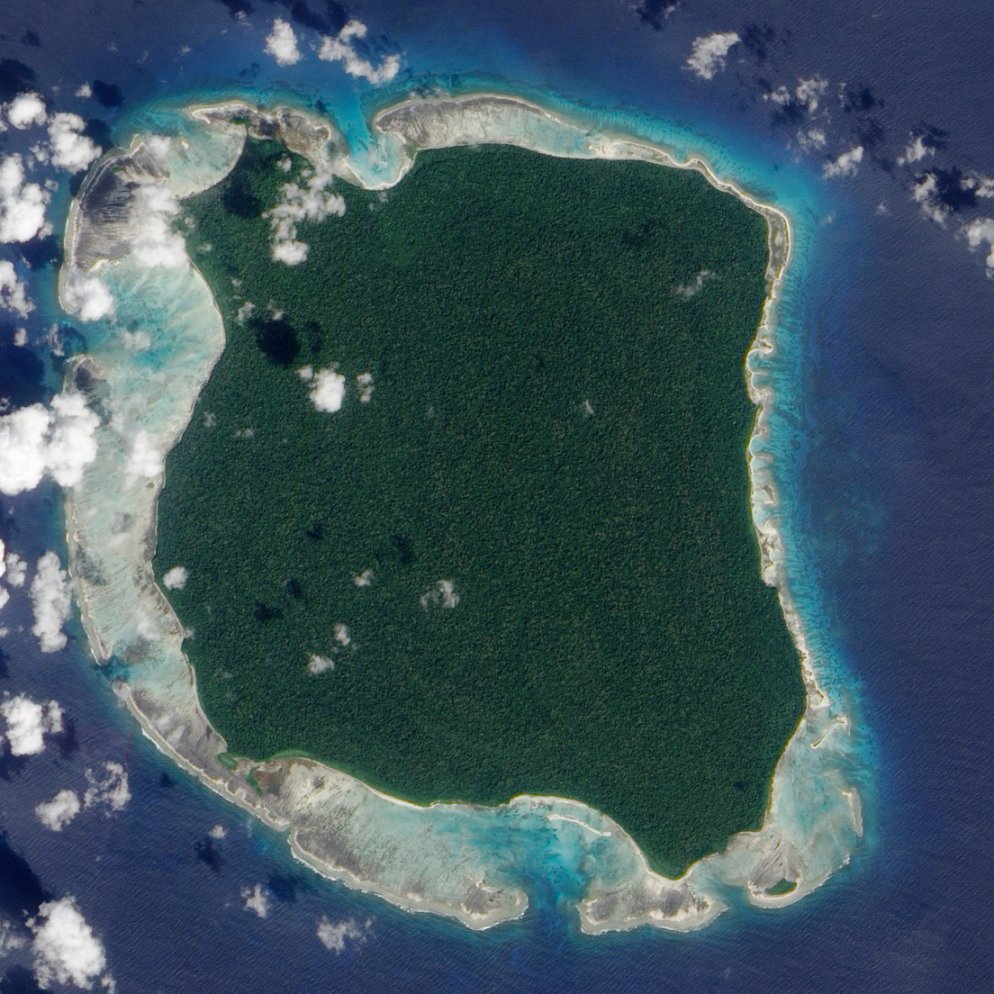
In November 2018, Indian Coast Guard vessels approached the shore of North Sentinel Island in the Indian Ocean carrying a crew of seven searching for a body. They knew that getting close meant almost certain death, but international protocol required them to attempt the recovery of twenty-six-year-old American missionary John Allen Chau, killed by arrows a week earlier when he tried to reach the island. The boats approached cautiously, crew members wearing bulletproof vests despite the fact that the island’s inhabitants use only bows and arrows. When they were still two hundred meters from shore, a group of naked men carrying bows appeared on the sand and began shouting and gesturing aggressively. One of them fired an arrow that struck the side of the lead boat. The mission commander immediately ordered a retreat — Indian law prohibits any contact with the island’s inhabitants under any circumstances, even for the purpose of recovering a body. Chau remained on the beach. His remains were never retrieved.
North Sentinel Island is one of the most mysterious and dangerous places on earth — a small landmass of sixty square kilometers in the Andaman archipelago, thirty kilometers from the nearest inhabited island. Between fifty and two hundred people live there; no one knows the exact number because no one can get close enough to count them. These people live exactly as human beings lived sixty thousand years ago, refuse all contact with the outside world, and kill immediately anyone who attempts to reach them. The Indian government declared the island a fully restricted zone in 1956, and anyone approaching within five kilometers faces up to three years in prison. But the real reason behind the prohibition goes beyond protecting the inhabitants from modern disease. Something stranger happens to everyone who tries to approach that island.
The Attempts That Ended in Death
The documented history of the island is filled with failed and fatal contact attempts. In 1867, a British merchant vessel called the Nineveh ran aground near the shore and a crew of eight went ashore to search for fresh water. None of them returned. A rescue ship arrived two days later and found the small boat empty on the beach with traces of blood but no bodies anywhere. In 1880, British official Maurice Vidal Portman led a military expedition of twenty armed soldiers to the island and succeeded in abducting six inhabitants — an elderly couple and four children — transporting them to Port Blair on a neighboring island. The couple died within a week from an unidentified illness, despite being examined by physicians who found no obvious infection. Portman, fearing the children would die as well, ordered them returned to the island. When the expedition reached the shore, dozens of inhabitants attacked with arrows; the children were thrown onto the beach and the expedition fled without knowing whether they survived. In 1974, an Indian documentary film company attempted to shoot footage of the island. Their ship approached the shore and the director’s team descended in a small inflatable boat, filming from two hundred meters out. Around twenty men emerged from the forest screaming and carrying bows. They released a volley of arrows: one struck the director in the thigh, another hit the camera assistant in the shoulder. The team fled to the main vessel, but the director died three days later in hospital from a severe infection that spread from the wound despite treatment with the strongest available antibiotics. The death report noted that the bacteria responsible was “unknown and unresponsive to any treatment” and that samples taken were sent to a government laboratory in Delhi — after which the files disappeared and no official report was ever published. The documentary was never completed, and the small amount of footage that was captured was classified by the Indian government and remains in a closed archive.
The Survivors Who Would Not Speak
There are only two documented cases of people who approached the island’s inhabitants and survived, and both are disturbing in different ways. The first was in 1991, when Indian anthropologist Madhumita Das managed to approach a small group of inhabitants at the edge of the beach. Her team had brought coconuts and fish as gifts, and for the first time in recorded history the inhabitants accepted the offerings without attacking. But Das wrote in her official report that the inhabitants stared at her team in a way that was “not normal” and that she felt “something was wrong with their eyes.” The way they moved, she wrote, resembled “predators studying their prey.” After only ten minutes the inhabitants began screaming and gesturing violently and the team retreated to their boats. Das refused to return to the island despite the government offering substantial funding to continue the research. In a rare 2003 interview she said she had seen something in the forest behind the inhabitants but refused to describe it, saying only: “Some things should remain buried on distant islands.” The second case was in 2006, when ocean currents carried a small Indian fishing boat onto the island’s shore while its two occupants slept. When they woke they found themselves surrounded by dozens of inhabitants with drawn bows. They tried to escape; the inhabitants shot them immediately. A Coast Guard helicopter flew over the area the next day and photographed the two bodies buried shallowly in the beach sand. What struck the analysts studying the photographs was that the inhabitants had not approached the boat itself or touched any of its contents — valuable equipment including fishing nets and an outboard motor remained completely untouched. An anthropologist reviewing the photographs noted that the way the bodies had been buried “did not appear random but seemed to follow a specific ritual pattern,” though he could not identify what that pattern was.
The Island That Defies Science
Scientists know very little about the Sentinelese because all information comes from distant observation via aircraft and binoculars. They are believed to be among the oldest peoples on earth, having separated from the rest of humanity approximately sixty thousand years ago with no subsequent mixing with any other population. Their language is entirely unknown and bears no resemblance to any other recorded language, including those of neighboring tribes in the Andaman archipelago. Limited genetic analysis conducted on old samples indicates that their DNA contains sequences not found in any other human group. Indian geneticist Lalji Singh, who studied these samples, stated at a 2009 scientific conference that there were “unexplained genetic differences” and that certain sequences “do not correspond to anything in the human genetic database,” but declined to elaborate and said the full study had “not been published for ethical reasons.”
Local fishermen who operate in the surrounding waters have reported, in informal accounts, seeing “orange lights” moving above the forest canopy in the middle of the night — despite the fact that the Sentinelese are not known to use fire for illumination. Others describe hearing “strange drumming sounds” that continue for hours on certain nights. One fisherman who declined to be named told a journalist in 2015 that he had once observed “a group of inhabitants standing in a circle on the beach at midnight, motionless, staring upward for more than an hour.” None of these accounts can be verified because approaching the island at night constitutes a serious legal violation.
The Secret That Will Not Be Told
When the 2004 Indian Ocean tsunami struck — killing more than two hundred thousand people across the region — North Sentinel Island was only one hundred kilometers from the earthquake’s epicenter. Relief aircraft flew over the island in the days following the disaster to check on the inhabitants. To everyone’s astonishment, the Sentinelese were alive and moving normally on the beach. One of them raised his bow and fired an arrow at the helicopter, which was flying at an altitude of one hundred and fifty meters. Scientists could not explain how the inhabitants survived a ten-meter tsunami wave that devastated every neighboring island. The official hypothesis — that they sensed the earthquake and moved to higher ground — is undermined by the fact that the island has no significant elevation; its highest point is ninety-eight meters above sea level. A classified government report leaked in 2011 stated that the scientific team that studied the island after the tsunami found that “vegetation and trees in certain areas of the island showed no damage from the wave despite being in its direct path,” and that this “cannot be explained by known natural conditions.” The report was never officially released.
Perhaps the inhabitants of this island know something we do not. Or perhaps there is something in that land that protects them from the outside world and kills everyone who tries to approach. Or perhaps they are the last remnant of something very old — older than we imagine and stranger than we can accommodate. The question that will not close is why these people refuse all contact with such lethal consistency, what happens on that island in the nights when the strange lights appear above the forest, and why everyone who has approached with peaceful intentions has died. No one knows. No one will find out. Getting close enough to answer the question means not coming back to report it — and that, perhaps, is exactly how the island intends to keep its secrets.